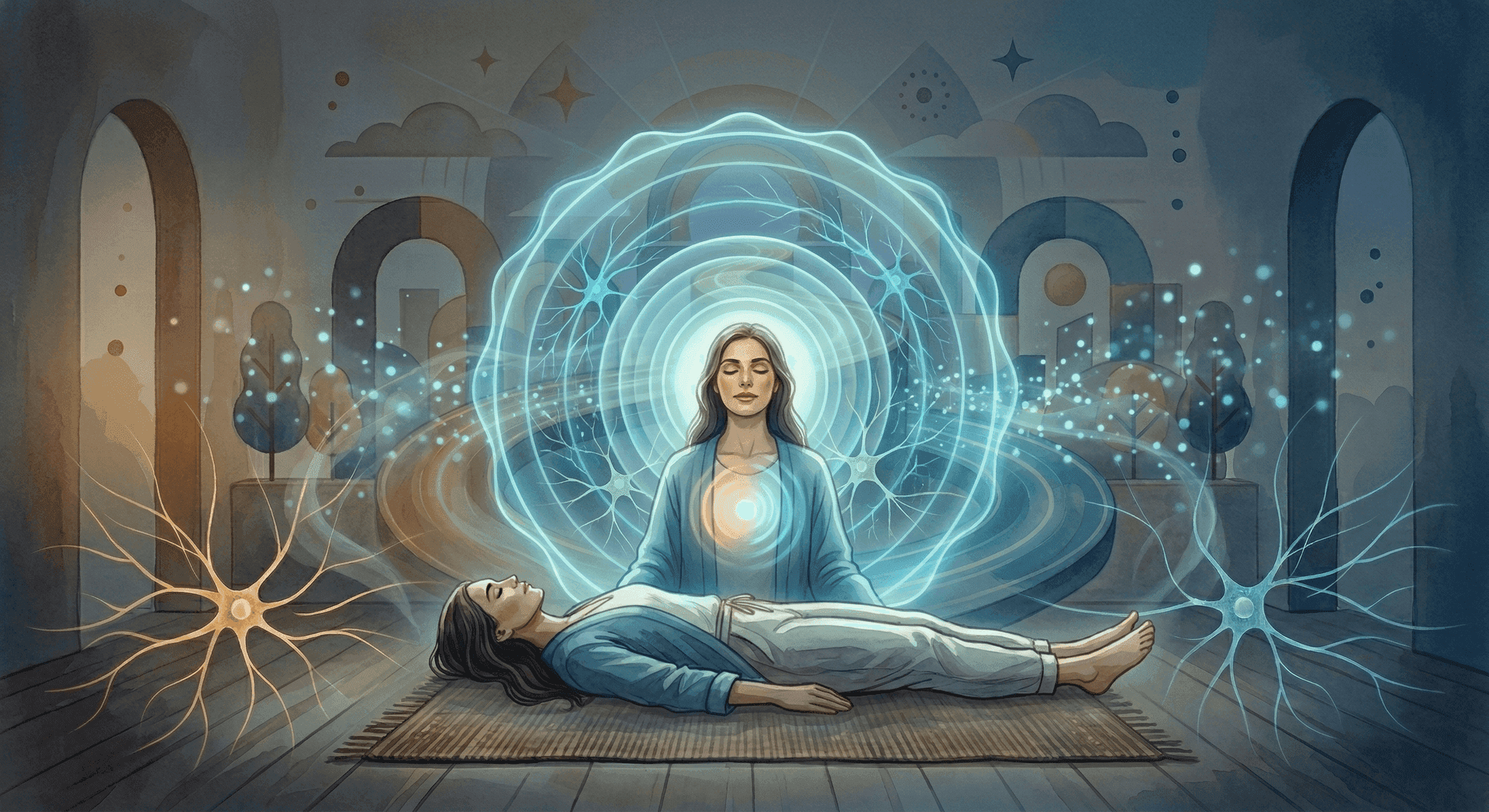
Paced Breathing: Calm Your Mind in 60 Seconds
Paced breathing is a scientifically proven technique that involves consciously slowing down your breath to calm your nervous system. U.S. scientists and researchers have discovered that by deliberately extending your exhalations, you send a direct physical signal to your brain that you're safe. This simple act lowers your heart rate, reduces stress hormones like cortisol, and turns down the alarm bells in your mind. Studies show that just five minutes of paced breathing can significantly reduce anxiety and improve your mood. Whether you're dealing with a sudden wave of panic, feeling overwhelmed at work, or trying to unwind after a long day, paced breathing offers a fast, accessible way to regain control. It's a powerful tool you can use anywhere to instantly shift your body back to a state of calm. Which pattern fits depends on how high you are: box breathing suits a five, and at a nine the counting itself becomes too much. That is the call EmoFlow-AI makes with you - you say how it is, it picks the pace.
Measurable increase in resting HRV (RMSSD increases by 10-20% in studies)
Breathing at roughly 6 breaths per minute coincides with the resonant frequency of the baroreflex loop
What Is This Technique?
At its core, paced breathing is the practice of regulating your respiratory rate, typically slowing it down to about six breaths per minute. Unlike your regular breathing, which happens automatically, paced breathing requires active control and mental focus. The most critical element is making sure your exhale is noticeably longer than your inhale. This isn't just a simple relaxation trick; it's a profound physiological intervention. By changing how you breathe, you press on the long nerve that runs from the brain down through the chest - the body's main brake on a stress response. It forces your 'rest and digest' network to activate. Used in clinical therapy and by military personnel to maintain composure under pressure, recent research proves that how you breathe directly dictates how you feel.
How Does It Work?
Paced breathing works by leaning on a brake the body already has. When you extend your exhalation, the movement of your diaphragm mechanically stimulates this nerve. This increases Respiratory Sinus Arrhythmia (RSA), naturally slowing your heart rate as you breathe out. Breathing at six breaths per minute creates 'baroreflex resonance,' maximizing your heart rate variability (HRV) and sending calming signals to your brainstem. The alarm side stands down: your body puts out fewer stress hormones, and the part of you that shouts danger goes quieter. Brain scans show that five minutes of this leaves the alarm less jumpy and gives the part of you that thinks clearly more of a say (Critchley et al., 2015). Regular practice also improves your physical tolerance to carbon dioxide, which recalibrates your body's alarm system and reduces baseline anxiety over time.
Sources: Zaccaro et al. (2018) - systematic review of slow breathing and the autonomic nervous system. doi:10.3389/fnhum.2018.00353, Critchley et al., 2015. doi:10.1371/journal.pone.0127082, Balban et al., 2023. doi:10.1016/j.xcrm.2022.100895, Meuret et al., 2010. doi:10.1037/a0019552
Step-by-Step Guide
- 1
Find a Comfortable Position
Sit or lie somewhere you will not be interrupted for five minutes. Back straight, shoulders down - they creep up towards your ears without you noticing. Unclench your jaw and let your tongue rest. Put one hand on your belly and one on your chest: that is your feedback. Throughout this, the belly hand should be the one that moves. Chest-only breathing is the shallow kind, and it never reaches the brake.
- 2
Inhale Slowly
Breathe in quietly through your nose for a slow count of four. Aim the air low - you should feel your belly push out against your hand while the chest hand stays more or less still. Nose rather than mouth: the nose filters, warms and slows the air, and that route engages the calming side of the nervous system better. If four seconds feels long tonight, use three. The ratio matters more than the exact numbers.
- 3
Pause Briefly
Hold gently for a count of two. Gently is the operative word - no gripping in the throat or chest, just let the air sit there. The pause lets carbon dioxide rise slightly, which is part of what triggers the calming reflex and sets up a fuller exhale. If holding makes you anxious, or gives you that not-enough-air feeling, skip it entirely and go straight to breathing out. The hold is optional; the long exhale is not.
- 4
Exhale Completely
Breathe out slowly through your mouth for a count of six. This is the part that does the work: the brake engages on the way out, which is why out-longer-than-in is the whole mechanism. Purse your lips slightly, as if you were fogging a mirror rather than blowing out candles. Empty your lungs properly and feel your belly fall back towards your spine. If you can only remember one thing from this page, make it this step.
- 5
Repeat and Observe
Keep the cycle going for at least five minutes - roughly fifteen to twenty rounds. Your mind will wander; that is not failure, just bring it back to the counting. When you finish, sit for a few seconds and check what changed: shoulders lower, jaw looser, thoughts less loud. If you feel light-headed, you are breathing too hard - make it softer and shorter, and the dizziness settles within a minute.
When Should You Use This?
You should use paced breathing whenever you feel overwhelmed, anxious, or notice your heart racing out of control. It's highly effective right before a stressful event, like a major public presentation, a difficult conversation, or a medical procedure. It's also an excellent daily tool for winding down before bed if racing thoughts are keeping you awake. Because it physically alters your nervous system's state in real-time, it's the perfect immediate response to sudden spikes in stress or panic. You can also use it proactively; practicing daily lowers your baseline stress.
- Who this is for
- For you when your body is ahead of your mind - heart going, chest tight, nothing obviously wrong. It is for the twenty minutes before something you are dreading, and for 2am when your brain will not switch off. You do not need to be anxious as a diagnosis to use it; you need to be somewhere you can breathe out slowly.
- When it fits in your week
- The car park before an appointment. The bathroom at a party. In bed at 2am, fourth night this week. Ten minutes before a presentation. Halfway through an argument, when you can feel your voice climbing. And on ordinary days when nothing is happening - that is where the reflex actually gets built.
- Why one pass is not enough
- Five good minutes tell you tonight went better. They cannot tell you that the tight chest arrives every Sunday evening, or always after the same person calls, or that it started when your sleep did. That pattern only shows up across weeks - and it is what decides whether you need a breathing practice or a change in something upstream of it. How the AI coach spots your patterns over weeks
If counting is already too much
- 1Forget the numbers. Breathe out longer than you breathe in, that is all. Two minutes.
- 2Out through the mouth, softly, like fogging a mirror - not blowing out candles.
- 3Hand on your belly. If only your chest is moving, aim the next breath lower.
- 4Feeling dizzy means it is too big, not that it is not working. Make it smaller.
- 5If your intensity is above nine, cold water on your face first. Breathing lands better afterwards.
Five lines to keep
- The exhale is the mechanism. In-four out-six is just a convenient way to make the exhale longer.
- About six breaths a minute is the resonance point of the baroreflex (Zaccaro et al., 2018) - not a wellness number.
- The hold is optional. If it makes you panicky, drop it; nothing important is lost.
- Ninety seconds gets you thinking again. Four to six weeks changes how fast you recover in general.
- Above nine out of ten, temperature first. Breathing is for the way down, not the peak.
When this needs a person, not a page
Breathing manages a moment and, over weeks, moves your baseline. It does not treat an anxiety disorder, and it is not a diagnosis.
- Breathlessness or chest pain that you have not had checked by a doctor - that comes first, always.
- Panic several times a week, or a life quietly rearranged to avoid where it happened.
- Breathing exercises reliably make you feel worse or more dissociated.
- You are not sleeping for weeks at a time, whatever you try.
If you are thinking about harming yourself, contact a crisis line or emergency services now. In the US you can call or text 988. This page is for reflection; it is not an emergency service.
Paced Breathing is a starting point - your coach picks what actually fits
Reading about Paced Breathing is one thing; doing it when you're overwhelmed is another. EmoFlow-AI starts with a feelings wheel to name what you're actually feeling among 130 emotions. Then a private AI coach - not you guessing or searching the web - chooses the practice that actually fits your check-in and your history, and walks you through it step by step, in the moment. It remembers what worked and builds a picture of your patterns over time. Not a chatbot that forgets you.
- Names what you feel among 130 emotions, then the coach picks the practice that fits - no guessing, no "which technique should I use"
- Walks you through it step by step, in the moment - not a static how-to
- Learns from your check-ins and history, remembers what worked, and shows your patterns
Free check-in, no account or card. Coaching is free to try for 3 sessions - nothing can auto-charge.
Start free check-inFor Mental Health Professionals
Clients who cannot access cognitive work while activated often can access this, because it asks nothing of the thinking brain. Assigned as homework, five minutes twice a day, it raises resting vagal tone over four to six weeks, which shows up as faster recovery between sessions rather than as calm during them. Two things are worth asking about in session: whether the hold phase increases panic, which is common and means dropping it, and at what intensity the counting stops being possible, because that number tells you when to move a client to temperature-based skills instead. EmoFlow-AI keeps that record between appointments so the answer is data rather than recall.
- Provides an immediate tool for downregulating the sympathetic nervous system
- Builds interoceptive awareness and distress tolerance between sessions
- Measurably improves HRV and baseline emotional regulation over time
Frequently Asked Questions
It is one of the better-studied things in this library. Zaccaro and colleagues (2018) pulled the studies together: at around six breaths a minute, breath and heartbeat fall into step and heart-rate variability goes up - the marker of a body that recovers quickly. A randomised Stanford trial (Balban et al., 2023, 108 participants over four weeks) found that five minutes a day of cyclic sighing improved mood more than mindfulness meditation of the same length. What it does not do is treat an anxiety disorder.
The first physical changes - slower pulse, less tension in the chest - usually show up inside the first four breaths, which is about ninety seconds. That is enough to think again, which is usually all you need in the moment. The longer effect works differently: practised a few minutes a day for four to six weeks, it resets how fast your body comes down after stress - so you settle quicker even on days you do not practise at all. Both are real; they just arrive on different timescales.
Yes, with one caveat worth knowing. During a panic attack, counting can be too much to hold on to, and trying to breathe deeply sometimes makes the not-enough-air feeling worse. Drop the numbers entirely and do one thing: breathe out for longer than you breathe in, softly, through your mouth. If even that will not land, you are probably above nine out of ten, and cold water on your face is the faster route - the breathing works better once the body has come down a little.
Daily, and specifically on days when nothing is wrong. Five minutes in the morning or before sleep beats twenty minutes once a week, because what you are building is a reflex, not a skill you look up. After a few weeks of that, the pattern comes on its own when your chest tightens - which is the whole point, because the moment you actually need it is the moment you are least able to remember instructions.
Helpful For These Emotions
Related Articles
Ready to practice this technique?
Start a Check-in