Decatastrophizing: Your Brain Isn't Broken, It's Rehearsing
Decatastrophizing takes the chain apart one link at a time. You write down the worst thing you are picturing, in full, then ask three questions about it: how would I know if it happened, what is the more ordinary version, and what would I actually do if the bad one arrived. Four steps, about ten minutes. The reason it helps is not that the fear is silly - it is that a catastrophe imagined in one lump cannot be answered, and the same catastrophe broken into steps can. Worth saying before anything else: doing this does not mean something is wrong with you. Jumping to the worst case is a thinking habit, common enough to be unremarkable. What one round cannot show you is whether the same chain keeps returning, and EmoFlow-AI's coach reads your check-ins together, picks the practice from there and fits it to what is happening.
64% of anxious youth aged 9-13 no longer met diagnostic criteria after CBT including cognitive restructuring (Kendall et al., 1997)
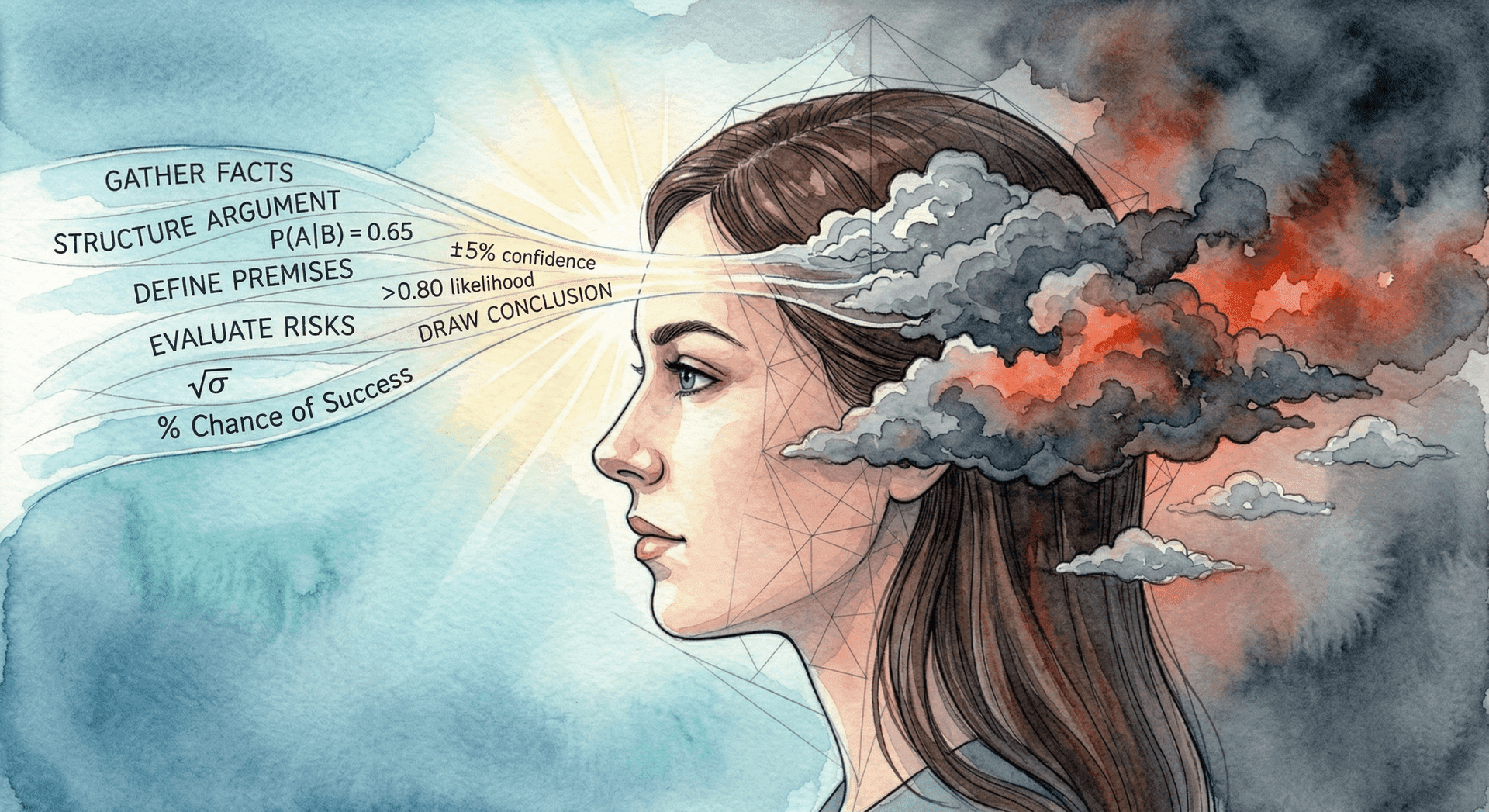
Reappraisal tasks show the deliberate part behind the forehead working harder while the brain's alarm fires less
What Is This Technique?
Catastrophizing is when a thought does not stop at the first bad outcome. The message goes unanswered, so they are annoyed, so the project is at risk, so the job is at risk, so everything is at risk - and each link feels like a reasonable step from the one before, which is exactly why the ending feels earned rather than invented. Decatastrophizing is the counter-move, and it is deliberately unexciting. You do not argue that the worst case is impossible, because arguing with it is what your head has been doing for an hour already and it has not worked. Instead you write it out in full, then ask what the most likely version looks like, and then - the step everyone skips - what you would actually do if the worst one happened. That last question is the one that does the work. The dread is rarely about the event. It is about facing it with nothing prepared.
How Does It Work?
A catastrophe held in your head arrives as one object, and one object cannot be examined. Writing the chain out turns it back into steps, and steps have joins - the place where "they did not reply" became "they are angry with me" is visible on paper and invisible in your head. That is most of the effect and it comes from the writing, not from the reassurance. The coping question does something separate. Anxiety is largely a prediction that you will not cope, more than a prediction that the thing will happen. Naming what you would actually do - who you would call, what the first week would look like - answers the prediction that is really running, and it does it without pretending the outcome is impossible. There is one situation where this backfires, and it is worth knowing before you start. If you return to the same chain repeatedly, checking whether the numbers still hold, the exercise has stopped being decatastrophizing and become reassurance-seeking - which strengthens the loop it was meant to interrupt. Once per chain. Not once per hour. One round shows you today. It cannot show you that the same catastrophe has come back in different clothes eight times this month, which is the thing worth working on. EmoFlow-AI's coach reads the check-in beside the history, picks the practice and fits it to the situation.
Sources: Cognitive Therapy of Depression (Beck et al., 1979) (book), Feeling Good: The New Mood Therapy (Burns, 1980) (book), Ochsner et al. (2002) - Rethinking feelings: an fMRI study of the cognitive regulation of emotion. doi:10.1162/089892902760807212
Step-by-Step Guide
- 1
Write the worst case out in full
All of it, in plain words, the ending included. Half-writing it keeps it powerful: a catastrophe you refuse to look at directly stays a shape in the dark. Written down, it usually reads as smaller and more specific than it felt - and specific is what the next three steps need. If it feels like tempting fate to write it, that is worth noticing too; the thought does not become more likely because it is on paper.
- 2
Find the joins in the chain
Read it back and mark each place where one thing became another. No reply became annoyed. Annoyed became the project is at risk. At risk became my job is gone. Then look at each join on its own and ask what else could sit there. You are not disproving anything - you are noticing that a chain of five reasonable-looking steps is not the same as one fact.
- 3
Write the ordinary version
Not the good version - the boring one. Usually it is something like: they were busy, they reply on Thursday, nobody mentions it again. If a friend described the same situation to you, this is the version you would offer without thinking. Write it next to the worst case so the two sit on the same page, because side by side is when the difference in evidence becomes obvious.
- 4
Answer the real question: what would I do?
If the worst case happened, what is the first thing you would do, and the second. Who you would call. What the first week would look like. This is the step people skip because it feels like inviting it - and it is the step that works, because the fear underneath is almost always about facing it with nothing prepared rather than about the event.
- 5
Stop, and do not come back to it today
One pass per chain. If you find yourself running it again in an hour to see whether the answer still holds, that is checking, and checking feeds the loop it was supposed to interrupt. Close the notebook and let the answer stand even if it does not feel finished. Feeling finished is not what this produces.
When Should You Use This?
Use it when the chain has already run and you can still hold a pen - usually after the peak, not at it. In the middle of a panic there is no arithmetic anybody can do, and asking for it just adds failure to fear. It fits the what-ifs with a shape: the health scare, the work email, the flight, the conversation you have not had yet. It fits badly on free-floating dread with no object, and there the check-in comes first. And it fits badly if you are already checking. If you notice you have run the same chain three times today looking for a better answer, stop doing the exercise and treat that as the problem instead.
- Who this is for
- For the person whose head runs the whole film from one unanswered message - and who has started to wonder whether that means something is wrong with them. It suits people who are articulate about the ending and vague about what they would actually do. If you are checking and rechecking rather than concluding, this is not your tool yet.
- When it fits in your week
- While something real is genuinely uncertain and the answer is weeks away: test results, a restructure, a visa, a conversation you have to have. Also in the months after something did go badly, when the machinery has a real case to point at and "be realistic" is not an argument against what you lived through.
- Why one pass is not enough
- One round shows you one chain. It cannot show you that the same catastrophe has returned in different clothes eight times this month, and that repetition is what points at the belief underneath. EmoFlow-AI's coach reads your check-in beside the history, picks the practice and fits it to the situation. It diagnoses nothing and it is not a therapist. How the AI coach spots your patterns over weeks
What people get wrong about it
Catastrophizing means you are irrational.
It means your threat system is doing what it was built to do, with the bias it was built with. Being wrong about a disaster costs an afternoon; missing a real one costs more. The habit is not a failure of intelligence, and people who are very good at thinking often have very detailed catastrophes.
You should tell yourself it will probably be fine.
That is the version that fails, because part of you knows you cannot promise it. The step that holds is the coping plan: not it will be fine, but if it is not, here is what I do first. That one survives contact with a bad outcome, which is exactly when you need it to.
Writing the worst case down makes it more likely.
Nothing on the page changes what happens. What changes is that a chain you can see has joins, and joins can be examined. The reluctance to write it is worth noticing though - it usually means the picture has more grip than you had admitted.
The short version
- Catastrophizing is a habit of thought, not a diagnosis, and not evidence that you are broken.
- Write the worst case out in full - half-written, it keeps its power.
- Mark the joins in the chain. Five reasonable steps are not one fact.
- The step that works is what would I do, not what are the odds.
- One pass per chain. Coming back to check turns the exercise into reassurance-seeking.
When this needs a person, not a page
This is a self-help exercise for reflection, not treatment. Some of this needs another person.
- The worst-case thinking has been stopping you working, eating or sleeping for weeks.
- You run the chain repeatedly for reassurance and the relief lasts minutes.
- The catastrophes centre on harming yourself or someone else.
- You are checking symptoms or news compulsively and cannot stop, which is a different pattern and has its own treatment.
Decatastrophizing is a starting point - your coach picks what actually fits
Reading about Decatastrophizing is one thing; doing it when you're overwhelmed is another. EmoFlow-AI starts with a feelings wheel to name what you're actually feeling among 130 emotions. Then a private AI coach - not you guessing or searching the web - chooses the practice that actually fits your check-in and your history, and walks you through it step by step, in the moment. It remembers what worked and builds a picture of your patterns over time. Not a chatbot that forgets you.
- Names what you feel among 130 emotions, then the coach picks the practice that fits - no guessing, no "which technique should I use"
- Walks you through it step by step, in the moment - not a static how-to
- Learns from your check-ins and history, remembers what worked, and shows your patterns
Free check-in, no account or card. Coaching is free to try for 3 sessions - nothing can auto-charge.
Start free check-inFor Mental Health Professionals
Clients prone to catastrophizing often struggle to perform evidence-gathering reality checks outside of the clinical setting. EmoFlow acts as a digital cognitive restructuring workbook, requiring clients to log their catastrophic predictions and calculate objective probabilities in real time. When a client uses the tool, it generates an organized Session Prep Report summarizing their worst-case scenarios, the alternative outcomes they generated, and their coping plans. Reviewing this detailed history during sessions allows you to see the exact themes of their cognitive distortions without relying on subjective memory. This objective record helps you identify recurring avoidance patterns and focus clinical time on dismantling the intolerance of uncertainty that sustains their anxiety.
- Track client adherence to cognitive restructuring exercises between appointments
- Review catastrophic themes and calculated probabilities directly in the Session Prep Report
- Shift session focus from anxious venting to building practical coping strategies
Frequently Asked Questions
No. It is a pattern of thought, not a diagnosis, and there is no condition by that name. It shows up more often in people dealing with anxiety, depression or chronic pain, and it also shows up in a great many people with nothing at all going on - including, reliably, anyone who has been through something that actually did go wrong. If your worst-case thinking is stopping you working or sleeping for weeks, that is worth taking to a professional. But the habit on its own is not evidence that something is wrong with you.
Because it is cheaper to be wrong in that direction. A brain that rehearses disaster and is wrong loses an afternoon; a brain that fails to see a real one loses more. So the machinery is biased, and it is biased in everybody. It gets louder when you are tired, when something genuinely uncertain is pending, and especially after a time when the bad thing did happen - after that, your head has evidence for its case, and "be realistic" is not an argument against experience.
Then the exercise still works, but the useful half is the last step rather than the middle. When the redundancy really is coming, weighing probabilities is beside the point and the coping plan is the whole value: what you would do first, who you would tell, what the first week looks like. Notice that this is a different situation from a distorted thought, and treating a real risk as a thinking error is its own kind of unhelpful.
The opposite, and it is the most common misreading. Step four is preparation - the actual kind, with names and first actions in it. What you stop doing is rehearsing, which feels like preparing and produces nothing. The test is simple: at the end of real preparation something is written down that you could act on. At the end of an hour of rehearsal there is nothing but a tighter chest.
Two reasons, and both are fixable. If you only imagine the ending and never get to what you would do about it, you have spent twenty minutes deepening the image with no exit - that is rehearsal, not decatastrophizing. And if you keep returning to check whether your answers still hold, you are seeking reassurance, which relieves for minutes and strengthens the loop over weeks. One pass, all four steps, then leave it.
Helpful For These Emotions
Related Techniques
Ready to practice this technique?
Start a Check-in