The DBT STOP Skill: Pause Before You React or Regret
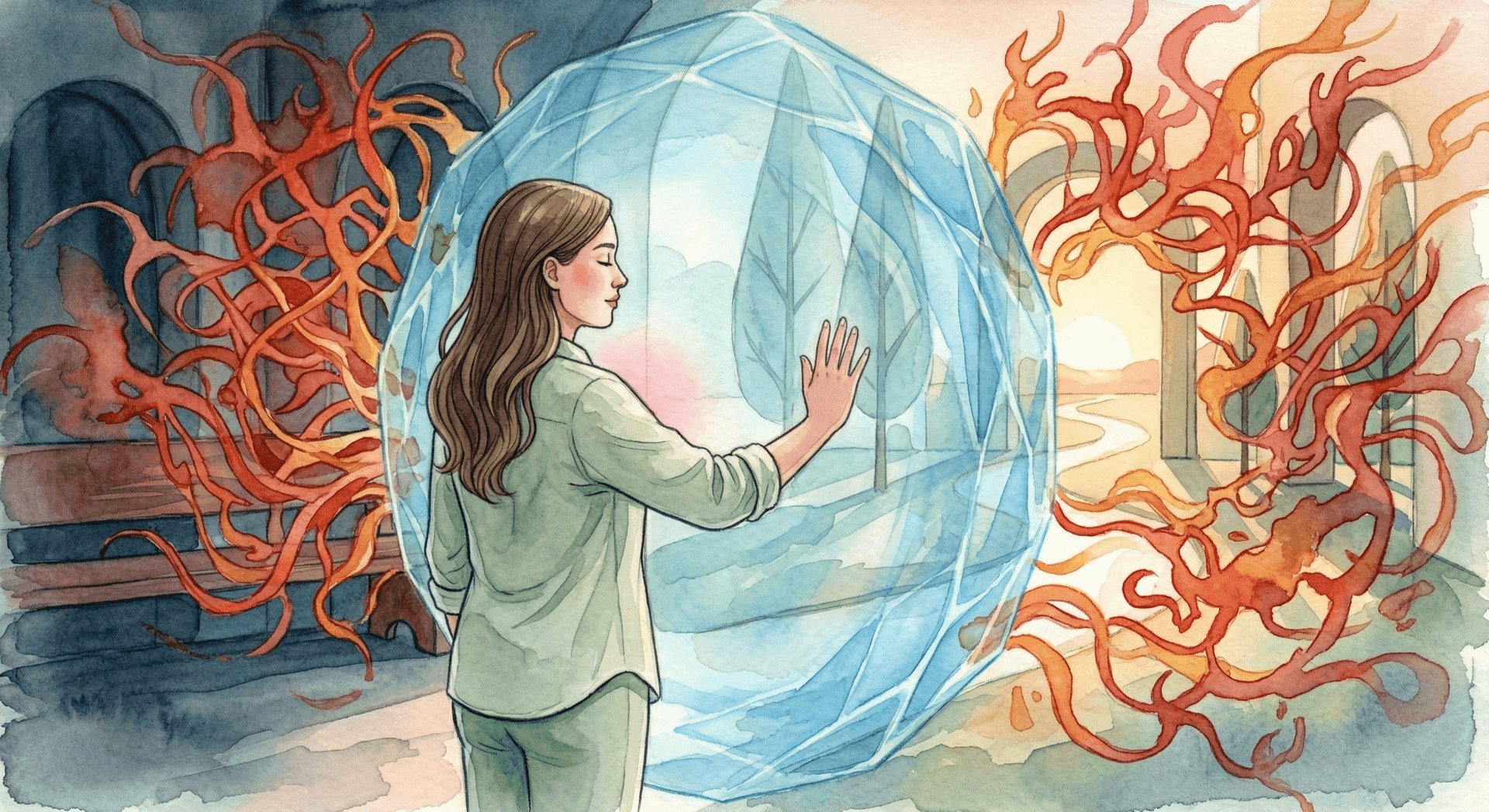
The DBT STOP skill is a four-step distress tolerance technique - Stop, Take a step back, Observe, Proceed mindfully - that helps you pause before you react so an emotional impulse does not choose your next move for you. It works because pausing the action and naming what you feel calm the brain's alarm system: putting a feeling into words quiets that alarm and switches on the part behind your forehead that weighs things up (Lieberman et al., 2007). Your brain's fast alarm reacts almost instantly, while the thinking part needs a moment longer to catch up, and most regrettable words and texts happen in that gap. The STOP skill builds a deliberate 6-10 second pause into that window. Not to suppress the feeling, but to choose how you act on it. Picking the right skill is its own job, hardest at the peak, so EmoFlow-AI makes that call from your check-in - and above an 8 it starts with the body, where thinking steps cannot reach yet.
Naming a feeling changes what the brain does with it: in a brain-scan study, putting emotions into words dampened the alarm's response to negative images and raised activity behind the forehead, in the part that weighs things up (Lieberman et al., 2007).
The deliberate stop is trainable: after ten sessions on a laboratory stop-signal task, activity in the inhibitory control network moved toward preparing the stop in advance rather than braking at the last moment, and the authors report that the gain did not transfer to other tasks (Berkman, Kahn & Merchant, 2014).
What Is This Technique?
The STOP skill is a core distress tolerance practice from Dialectical Behavior Therapy (DBT), developed by psychologist Marsha Linehan (2015). In DBT it belongs to the distress tolerance module, which sits alongside the emotional regulation skills: this one buys the pause, and the work of shifting the feeling itself comes after. STOP is an acronym for four steps done in sequence: Stop (freeze the action), Take a step back (breathe and create distance), Observe (notice your body, emotions, thoughts, and the facts), and Proceed mindfully (choose an action that fits your goal). The whole sequence takes 30 seconds to 2 minutes. Think of it as a crutch for the part of you that judges: when the feeling runs high enough that your judgment drops out, the sequence buys back the seconds it needs to come round. It is not emotion suppression - you do not push the feeling down. The STOP skill pauses the action while the emotion stays present, to be honored in the Observe step. Deliberate stopping is trainable - as a skill, not as a switch that flips by itself. In one training study, ten sessions on a stop-signal task moved the brain's control network toward getting ready to stop early rather than braking at the last moment. The authors are clear that this stayed inside the trained task and did not carry over to others (Berkman, Kahn & Merchant, 2014).
How Does It Work?
Here's what's happening in your brain, in plain terms. When something sets you off, two parts of your brain react at different speeds. A fast alarm fires almost instantly and pushes you to snap, hit send, or lash out. A slower, wiser part - the bit behind your forehead that weighs consequences - needs a moment longer to catch up. Under stress the alarm wins, and your thinking brain goes quiet right when you need it most (Arnsten, 2009). That's not weakness, it's biology. The STOP skill buys your thinking brain the second it needs: freezing your body helps it hit the brakes, a long slow exhale calms your nervous system and lowers your heart rate (Lehrer & Gevirtz, 2014), and simply naming what you feel turns the alarm's volume down - in the scanner, putting a feeling into words quieted the alarm's response and lit up the part behind your forehead that weighs things up (Lieberman et al., 2007). Timing matters too: the pause has to land in the first few seconds, before the words are out - and 6-10 seconds is enough for your thinking brain to start coming back.
Sources: Lieberman, M. D., Eisenberger, N. I., Crockett, M. J., et al. (2007). Putting feelings into words: Affect labeling disrupts amygdala activity in response to affective stimuli. Psychological Science, 18(5), 421-428. https://doi.org/10.1111/j.1467-9280.2007.01916.x, Arnsten, A. F. T. (2009). Stress signalling pathways that impair prefrontal cortex structure and function. Nature Reviews Neuroscience, 10(6), 410-422. https://doi.org/10.1038/nrn2648, Berkman, E. T., Kahn, L. E., & Merchant, J. S. (2014). Training-induced changes in inhibitory control network activity. Journal of Neuroscience, 34(1), 149-157. https://doi.org/10.1523/JNEUROSCI.3564-13.2014, Lehrer, P. M., & Gevirtz, R. (2014). Heart rate variability biofeedback: How and why does it work? Frontiers in Psychology, 5, 756. https://doi.org/10.3389/fpsyg.2014.00756, Linehan, M. M. (2015). DBT Skills Training Manual (2nd ed.). Guilford Press. Book - the origin of the STOP skill.
STOP vs TIPP: which to reach for
STOP and TIPP are both DBT distress tolerance skills, and they are easy to mix up. Quick rule: reach for the STOP skill when you are about to act on an urge, and TIPP when your body is too flooded to think.
| STOP | TIPP | |
|---|---|---|
| What it is | A four-step pause skill: Stop, Take a step back, Observe, Proceed mindfully. | Four fast body-based tools: cold temperature, intense exercise, paced breathing, and paired muscle relaxation. |
| Best when | You are about to act on an urge - text, quit, snap, walk out - and want a gap before you do. | Your body is flooded and your thinking brain feels offline, and you need to bring the intensity down first. |
| How it helps | Puts a deliberate pause between the urge and the action so you get to choose your next move. | Shifts your physiology directly through cold, movement, and breath to lower the intensity fast. |
| How long | Seconds to a minute. | A few minutes. |
| Try it for | Conflicts, impulsive urges, the I am about to do something I will regret moment. | Panic, rage, or overwhelming distress when you cannot think straight. |
Step-by-Step Guide
- 1
Stop
Stop. Freeze completely - do not move, do not speak, do not hit send. Picture someone pressing pause on a movie. If you are typing, put the phone down; if you are mid-sentence, close your mouth. That stillness isn't just symbolic - stopping your body helps your brain hit the brakes too. Remember, the STOP skill pauses the action, not the emotion - the feeling stays and gets honored next.
- 2
Take a Step Back
Take a step back. Physically lean back or leave the room if you can, and take one to three slow breaths with the exhale longer than the inhale - try in for four, out for six. That longer exhale flips your body out of fight-or-flight and starts to undo the adrenaline surge. If you cannot move, step back mentally: imagine a glass wall between you and the trigger. Unclench your jaw and drop your shoulders to signal safety.
- 3
Observe
Observe. Notice what is happening inside and outside you, without judging it. Scan your body: racing heart, hot face, clenched jaw - where do you feel it? Name the emotion, because labeling it (silently is enough) loosens its grip. Then separate facts from your story: what would a security camera have recorded, versus what are you assuming or predicting? Observation is descriptive, not evaluative. My heart is pounding and I feel angry is observing; they are a jerk is judging.
- 4
Proceed Mindfully
Proceed mindfully. Ask what you want to happen here, and which action future-you would be proud of. Choose one response that fits that goal: it might be speaking up, setting a firm boundary, walking away, or doing nothing for now and revisiting in an hour. Proceeding mindfully does not mean being passive - sometimes the wise action is a strong one. The difference is that you chose it, rather than letting stress hormones choose for you. When unsure, wait one hour.
When Should You Use This?
Reach for the STOP skill when your emotional intensity is high (roughly 7 to 10) and you feel an urge to act you might regret. Use it when you are about to send an angry text, when an argument with your partner is escalating, when a colleague's comment lands and your fingers are already typing a sharp reply, or when a moment of frustration tempts you to quit something important. It also helps before impulsive money or life decisions made under emotional pressure. Do not use it when you face real physical danger and immediate action keeps you safe - the STOP skill is for when the threat is to your ego, reputation, or relationships, not your body. At intensity 8 or higher, shrink it to: freeze, walk away, breathe, wait one hour.
- Who this is for
- For you if the thing you regret is almost never what you felt, only how fast it came out - the reply sent in nine seconds, the sentence that landed before you heard yourself say it. It suits people who do not want to be calmer, only to keep their hands still long enough to decide. The anger stays; the timing changes.
- When it fits in your week
- It belongs in the small stuff long before it belongs in the big stuff. The slow lane on the way to work, the third identical email, the kettle that clicked off cold. Three or four of those a day, thirty seconds each, is the whole practice. The hard moment is not where you learn this; it is where you spend what you already learned.
- Why one pass is not enough
- One good pause tells you today went differently. It cannot tell you that the same Thursday meeting keeps putting you there, and that is the part that decides whether you need a skill or a conversation. In EmoFlow-AI the journal writes itself out of your check-ins, so the repeat shows up as a pattern. It does not tell you what to do about the trigger. How the AI coach spots your patterns over weeks
A Worked Example: The Family Group Chat
Same four steps, an ordinary Tuesday night. Nothing dramatic - just the kind of thirty seconds that decides whether you spend the next week explaining yourself.
About forty seconds and one cup of tea. The anger was not wrong and it did not go anywhere - it just did not get to write the message.
Myths About the STOP Skill
The STOP skill means suppressing your anger.
The STOP skill pauses the action, not the emotion. You still feel everything; you just choose how to act. The Observe step exists to name and honor the feeling, not bury it - and suppressed anger tends to leak out later as tension or resentment.
The STOP skill is just counting to ten.
Counting to ten is passive waiting. The STOP skill is an active four-step sequence, and each step does something different: stop the action, calm the body with your breath, name the feeling, and choose what to do next. Naming the emotion on its own already quiets the brain's fast alarm and brings in the part that weighs consequences (Lieberman et al., 2007).
Stopping means the other person wins.
Using the STOP skill means you decide what happens next instead of letting anger decide for you. Reacting on autopilot hands over control; pausing keeps it. The mindful response can still be firm - a clear boundary or a decisive no.
Proceeding mindfully means doing nothing.
Proceed mindfully means acting with intention, not being passive. Sometimes the wise action is a strong one - speaking up, leaving, or setting a boundary. The STOP skill only changes whether the action is chosen or reactive.
When to Reach Out for Professional Support
The STOP skill is an evidence-based self-help tool for reflection and impulse control, not treatment. Some situations need more than a moment-of-need skill.
- Pausing makes you feel more agitated or dissociated rather than calmer, again and again.
- The same triggers keep exploding no matter how often you use the STOP skill.
- Your intensity stays at 9 or 10 after 20-30 minutes of STOP plus breathing.
- You are managing self-harm urges, chronic suicidal thoughts, trauma flashbacks, or substance cravings - the STOP skill can be a bridge, but it is not a standalone intervention.
If you are thinking about harming yourself, contact a crisis line or emergency services now. In the US, call or text 988. EmoFlow-AI is a reflection tool, not an emergency service.
DBT's STOP skill is a starting point - your coach picks what actually fits
Reading about DBT's STOP skill is one thing; doing it when you're overwhelmed is another. EmoFlow-AI starts with a feelings wheel to name what you're actually feeling among 130 emotions. Then a private AI coach - not you guessing or searching the web - chooses the practice that actually fits your check-in and your history, and walks you through it step by step, in the moment. It remembers what worked and builds a picture of your patterns over time. Not a chatbot that forgets you.
- Names what you feel among 130 emotions, then the coach picks the practice that fits - no guessing, no "which technique should I use"
- Walks you through it step by step, in the moment - not a static how-to
- Learns from your check-ins and history, remembers what worked, and shows your patterns
Free check-in, no account or card. Coaching is free to try for 3 sessions - nothing can auto-charge.
Start free check-inFor Mental Health Professionals
The STOP skill is a core distress tolerance skill in dialectical behavior therapy, and the four steps on this page are the dependable way for a client to run this exact technique between sessions, on her own. What EmoFlow-AI adds is everything around those steps. A check-in records what she felt - from 130 emotions, and more than one at a time when that is what is happening - how strong it was on a 0 to 10 slider, the context (bad sleep, overload, conflict), the urge that came with it (approach, leave, fight, freeze) and the life domain it sits in: work, partner, family, social, personal. From that check-in the coach picks a practice and adapts it to her situation - this one, or a better fit for that moment - and stays with her step by step, asking follow-up questions until the intensity eases. Above an 8 it starts with the body, because the thinking steps need a prefrontal cortex that is back online. The journal writes itself out of those check-ins and sessions, so her recurring triggers and what actually helps her become visible over weeks - but only from sessions she finished and saved; one abandoned halfway never enters the picture. The dashboard reaches you as a single link, and she controls that access. It is not a crisis service.
- The four steps on this page: the dependable way for a client to run this exact technique on her own
- A check-in that records the emotion (from 130), its 0-10 strength, the context, the action urge and the life domain
- A dashboard she shares with you as one link, built only from sessions she finished and saved
Frequently Asked Questions
The trick with the STOP skill is preventive practice, not willpower in the moment. Practice STOP during low-stakes irritations - a slow driver, cold coffee, a mildly annoying email - three to five times a day. Rehearsing when calm is what puts the Stop step within reach once a real 8-out-of-10 wave hits and your thinking brain is offline. Deliberate stopping trains like a skill: across ten sessions on a stop-signal task, the brain's control network shifted toward getting ready to stop early instead of braking at the last moment (Berkman, Kahn & Merchant, 2014). The same authors are explicit that the gain stayed inside the trained task and did not carry over to other ones - so treat this as reps you actually put in, not as something that switches itself on later. You cannot install a brake during the crash; you train it beforehand.
The STOP skill was designed for distress tolerance in crises, to prevent self-destructive or impulsive behavior when emotions spike to 8 or higher. But it also works for everyday friction: pausing before a sarcastic reply, cooling off before an impulsive purchase, or stepping back mid-argument. Using it on small stressors is not a waste - it is exactly the training that makes the skill available during bigger ones. Think of low-stakes moments as reps in an emotional gym that build the same circuit you will lean on in a real storm.
Yes, with one modification. If your nervous system already defaults to freezing or dissociating, the first Stop step can deepen that shutdown, so skip it. Turn Take a step back into a step toward the present instead: ground yourself with sensory anchors - press your feet into the floor, hold something cold, name five things you can see. Keep the Observe step external (what is real in this room) rather than turning inward, which can pull you further into dissociation. The goal for freeze-type responders is to re-engage with the present, not to pause harder.
To stop yourself from sending an angry text, run the STOP skill on the action first. Stop: put the phone face-down and take your thumbs off the keyboard. Take a step back: move the phone to another room and breathe out slowly. Observe: name what you feel and what you actually want - to be heard, or to hurt them back? Proceed: write the message in your notes app, not the chat, and reread it after coffee tomorrow. A message sent in the first 30 seconds of anger is the one you can end up explaining for a week. Give it an hour and you may find you want to say it differently, or not at all.
You say things you regret when angry because the part of you that weighs consequences loses efficiency under a flood of stress chemicals (Arnsten, 2009). The faster alarm takes the wheel, and it does not calculate outcomes; it just fires defensive words. That is why the first 6-10 seconds after a trigger are the dangerous ones. The STOP skill puts a deliberate pause in that window so blood flow returns to your thinking brain before you speak. Regret is not a character flaw - it is a timing problem, and the STOP skill fixes the timing.
Here is a STOP skill example. Your boss criticizes your work in a meeting; your face goes hot and rebuttals are lining up. Stop: you stay quiet and keep your expression neutral. Take a step back: one slow breath, weight shifting back in your chair. Observe: is any of this feedback true, and what is my goal - to win now, or to be respected long term? Proceed: 'Thank you, I'll review these points and follow up.' Nobody in the room saw a technique happen. That is what it looks like in real life: about twenty seconds of quiet, and a sentence you can live with tomorrow.
Helpful For These Emotions
Related Techniques
Related Articles
Ready to practice this technique?
Start a Check-in