TIPP Skill (DBT): Survive a Crisis Fast
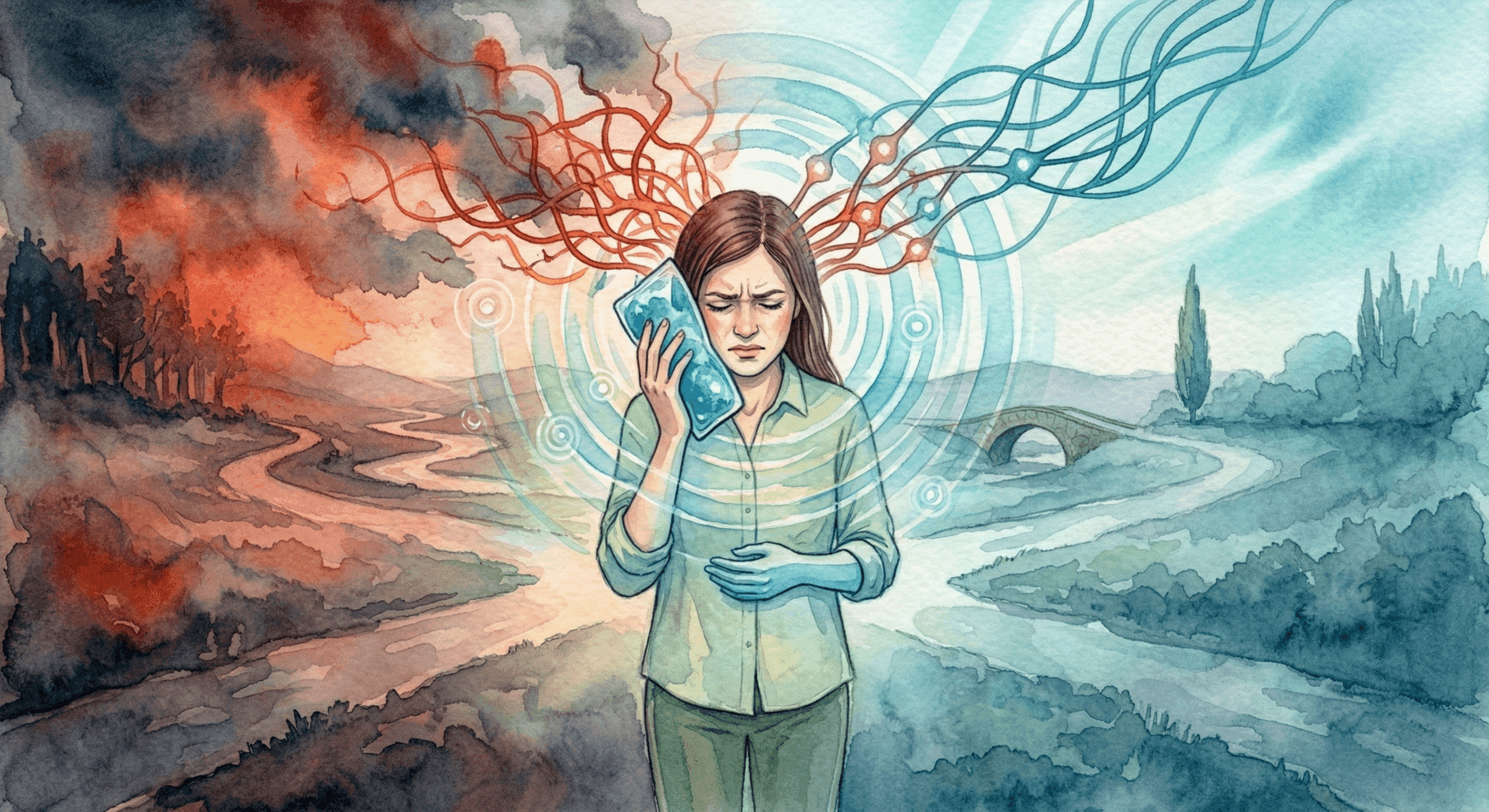
The TIPP skill is a four-step crisis survival technique from Dialectical Behavior Therapy (DBT) designed to rapidly halt extreme emotional distress. In real panic, rage or overwhelm, the body's accelerator is flat to the floor and thinking your way out is not on the table. TIPP bypasses this cognitive block by directly hacking your biology through four somatic interventions: Temperature, Intense exercise, Paced breathing, and Paired muscle relaxation. The first step, applying cold water to your face, triggers the mammalian dive reflex. Research shows this reflex decreases your heart rate by 10-25% within 15-30 seconds (Panneton, 2013). This provides the fastest non-pharmacological reduction in distress available. So instead of reasoning with a storm, you use four physical moves to put the brake back on, and reasoning becomes available again afterwards. Which of the four fits depends on where you are and what your body can safely do, and that is the part EmoFlow-AI decides with you - you say how it is, it picks the one that matches this intensity.
Mammalian dive reflex decreases heart rate by 10-25% within 15-30 seconds
Paced breathing at 5.5 breaths per minute optimizes heart rate variability resonance
What Is This Technique?
TIPP is an acronym representing Temperature, Intense exercise, Paced breathing, and Paired muscle relaxation. Developed by Dr. Marsha Linehan as part of the Distress Tolerance module, this systematic sequence addresses severe emotional dysregulation. When stress hits an eight or higher on a ten-point scale, the alarm takes over and the part of you that plans and decides drops out. At this stage, cognitive reappraisal tools fail because the neural pathways required to process language and logic are offline. TIPP attacks the problem biologically. It leverages evolutionary survival mechanisms to force the central nervous system out of an active fight-or-flight response. The sequence is deliberately staged, moving from the fastest-acting intervention - temperature - to slower, sustained techniques like progressive muscle relaxation. Working on four fronts at once burns off the stress chemistry already in your blood and puts the brake back on, which opens a window where the body is no longer bracing.
How Does It Work?
Each component of the TIPP sequence targets a distinct physiological system. The Temperature step utilizes the mammalian dive reflex. Immersing the forehead and eye area in cold water stimulates the trigeminal nerve, sending an immediate signal to the brainstem to slow the heart and consolidate blood to vital organs. Intense exercise follows, serving to metabolize the excess adrenaline and cortisol flooding the body. It also releases endorphins and raises BDNF, the growth factor the brain uses to build and keep connections. Paced breathing, ideally five or six breaths a minute with a long way out, presses the body's brake mechanically and brings breath and heartbeat into step. Finally, Paired muscle relaxation capitalizes on reciprocal inhibition. By deliberately tensing and releasing muscles in sync with breathing, you reset resting muscle tone to a lower baseline, extinguishing the physical markers of panic.
Sources: Dialectical Behavior Therapy Skills Training Manual (Linehan, 2015) (book), Szuhany, Bugatti & Otto (2015) - a meta-analytic review of the effects of exercise on brain-derived neurotrophic factor. doi:10.1016/j.jpsychires.2014.10.003, Ma et al. (2017) - the effect of diaphragmatic breathing on attention, negative affect and stress. doi:10.3389/fpsyg.2017.00874
How it differs from similar techniques
| What it does | Changes your body chemistry directly. | Changes what you are thinking about. |
| Works at | 8, 9 and 10, where thinking is offline. | Up to about 7, while you can still reason. |
| How fast | 15 to 30 seconds for the cold. | Minutes, and only if you can concentrate. |
| What it needs | Cold water, space to move, or a sink. | Enough attention to follow the steps. |
| What it does not do | It does not solve the problem. | It does not lower a nine. |
Step-by-Step Guide
- 1
Temperature (Ice Diving)
Fill a bowl with cold water (50-59°F) or grab an ice pack. Hold your breath and submerge your face, explicitly targeting the forehead and the area around your eyes. Maintain this position for 15-30 seconds. This action triggers the dive reflex, immediately dropping your heart rate. Do not use this step if you have a cardiac condition or cold-induced urticaria.
- 2
Intense Exercise
Straight after the cold, move hard for 10 to 20 minutes - hard enough that your heart is going and holding a conversation is difficult. Sprint, jumping jacks, stairs, punch a pillow, carry something heavy up and down the hall. This is not exercise for fitness; it is burning off the adrenaline and cortisol your body released and never used. Your body is asking for action, and this gives it action that costs nothing afterwards.
- 3
Paced Breathing
Now slow it down to five or six breaths a minute. Breathe into your belly for about five seconds, then let it out over five to seven. The out-breath has to be longer than the in-breath - that is the whole mechanism, because the body's brake engages on the way out. Do it for three to five minutes. If counting is too much right now, forget the numbers and simply breathe out for longer than you breathe in.
- 4
Paired Muscle Relaxation
Take one muscle group at a time, starting with your hands. Breathe in while you tense it to about seventy percent - firm, never painful - for five to seven seconds. Then breathe out and drop the tension all at once, not gradually, and stay there for fifteen to twenty seconds. Notice the difference between the two states. Work up: fists, arms, shoulders, face, chest, stomach, legs, feet. In the short crisis version, three areas is enough.
When Should You Use This?
TIPP is strictly a crisis survival skill. Employ the full sequence when your distress reaches an eight or higher on a ten-point scale - moments when you feel explosive rage, overwhelming panic, or paralyzing anguish. It is necessary when you are so dysregulated that you cannot communicate effectively or think clearly. You might use the dive reflex to halt a panic attack before a public speaking event, or use intense exercise to process the immediate shock and anger of a betrayal. Do not attempt cognitive reframing or problem-solving while in this state. TIPP is not designed to solve your problems; it exists entirely to bring your physiological arousal down to a manageable level so that you can subsequently access other emotion regulation tools to address the situation.
- Who this is for
- For you at the point where advice stops working. Nine out of ten, hands not steady, about to send the message or walk out of the building. It is not a calm-down routine for a stressful week - it is what you use when thinking has already gone offline and you need your body back before you can decide anything.
- When it fits in your week
- The middle of a fight that has stopped being about the thing. The five minutes after a phone call that changed something. A panic attack in a car park. The urge to hurt yourself. The moment before you send a message you cannot take back. And earlier than all of that, at a five or six, when fifteen seconds of cold now saves half an hour later.
- Why one pass is not enough
- TIPP gets you through tonight. It cannot tell you that the nines arrive on the same day each week, after the same person, in the same tiredness - and that is what decides whether you need a crisis skill or something upstream of the crisis. That pattern lives in weeks of small notes, and in someone who hears the whole story once you are out of it. How the AI coach spots your patterns over weeks
Thirty seconds, in this order
- 1Cold water on your face, holding your breath, fifteen to thirty seconds. Forehead and around the eyes - that is where the reflex lives. Skip this one if you have a heart condition.
- 2No bowl? Cold pack on the face, or the coldest tap you have, wrists and face.
- 3Then move: stairs, a fast walk to the end of the street and back, anything for ten minutes.
- 4Then breathe out longer than you breathe in, for three minutes. Forget counting if you cannot.
- 5Then squeeze your fists tight for five seconds and drop them. Three times. That is the whole short version.
When this needs a person, not a page
TIPP is a crisis-survival skill. It buys you the twenty minutes; it does not treat what keeps producing them.
- You are reaching a nine or ten several times a week.
- You are using it to get through urges to hurt yourself - that deserves a person alongside it, not a page on its own.
- The cold is not an option for you medically, and nothing else is bringing the intensity down.
- Afterwards you cannot remember what happened, or you lose hours.
If you are thinking about harming yourself, contact a crisis line or emergency services now. In the US you can call or text 988. This page is for reflection; it is not an emergency service.
TIPP is a starting point - your coach picks what actually fits
Reading about TIPP is one thing; doing it when you're overwhelmed is another. EmoFlow-AI starts with a feelings wheel to name what you're actually feeling among 130 emotions. Then a private AI coach - not you guessing or searching the web - chooses the practice that actually fits your check-in and your history, and walks you through it step by step, in the moment. It remembers what worked and builds a picture of your patterns over time. Not a chatbot that forgets you.
- Names what you feel among 130 emotions, then the coach picks the practice that fits - no guessing, no "which technique should I use"
- Walks you through it step by step, in the moment - not a static how-to
- Learns from your check-ins and history, remembers what worked, and shows your patterns
Free check-in, no account or card. Coaching is free to try for 3 sessions - nothing can auto-charge.
Start free check-inFor Mental Health Professionals
Teaching distress tolerance skills requires clients to practice somatic interventions when they feel safe, so the techniques remain accessible during an active crisis. EmoFlow bridges the gap between theory and application by serving as an interactive crisis toolkit on the client's phone. When a client performs the TIPP sequence between appointments, the app records their pre- and post-intervention arousal levels and compiles this data into a secure Session Prep Report. You can review this report to verify that clients are correctly executing physiological interventions instead of relying on maladaptive coping mechanisms. By tracking exactly which components - from ice diving to paced breathing - yielded the most significant objective drops in distress, you can optimize their personalized crisis survival plan during clinical hours.
- Track client utilization of crisis survival skills outside the clinical setting
- Analyze objective pre- and post-intervention intensity drops in the Session Prep Report
- Eliminate subjective recall bias regarding the effectiveness of somatic interventions
Frequently Asked Questions
You can absolutely use single components independently based on the situation and available resources. If you are experiencing a panic attack at work, a quick splash of cold water and paced breathing are discreet and highly effective. The full four-step sequence provides the most profound physiological reset for severe crises, but any single step will help lower your arousal.
Holding an ice cube in your hand creates an intense sensation that can help ground you, but it does not trigger the mammalian dive reflex. The specific receptors that activate the dramatic drop in heart rate are located along the ophthalmic branch of the trigeminal nerve, strictly around your forehead and eyes. Submerging your face simulates diving underwater.
Skip Temperature if you have a heart rhythm problem, long QT syndrome, Wolff-Parkinson-White, or blood pressure that is not under control - the dive reflex causes a sudden slowing of the heart, which is exactly what you do not want on top of those. The same applies if you take beta blockers, and if you have cold urticaria. None of that rules out the rest: intense movement scaled to what you can do, slow breathing and muscle relaxation are all still available. If you are unsure about your heart, ask your doctor before using the cold, not after.
Helpful For These Emotions
Related Techniques
Related Articles
Ready to practice this technique?
Start a Check-in