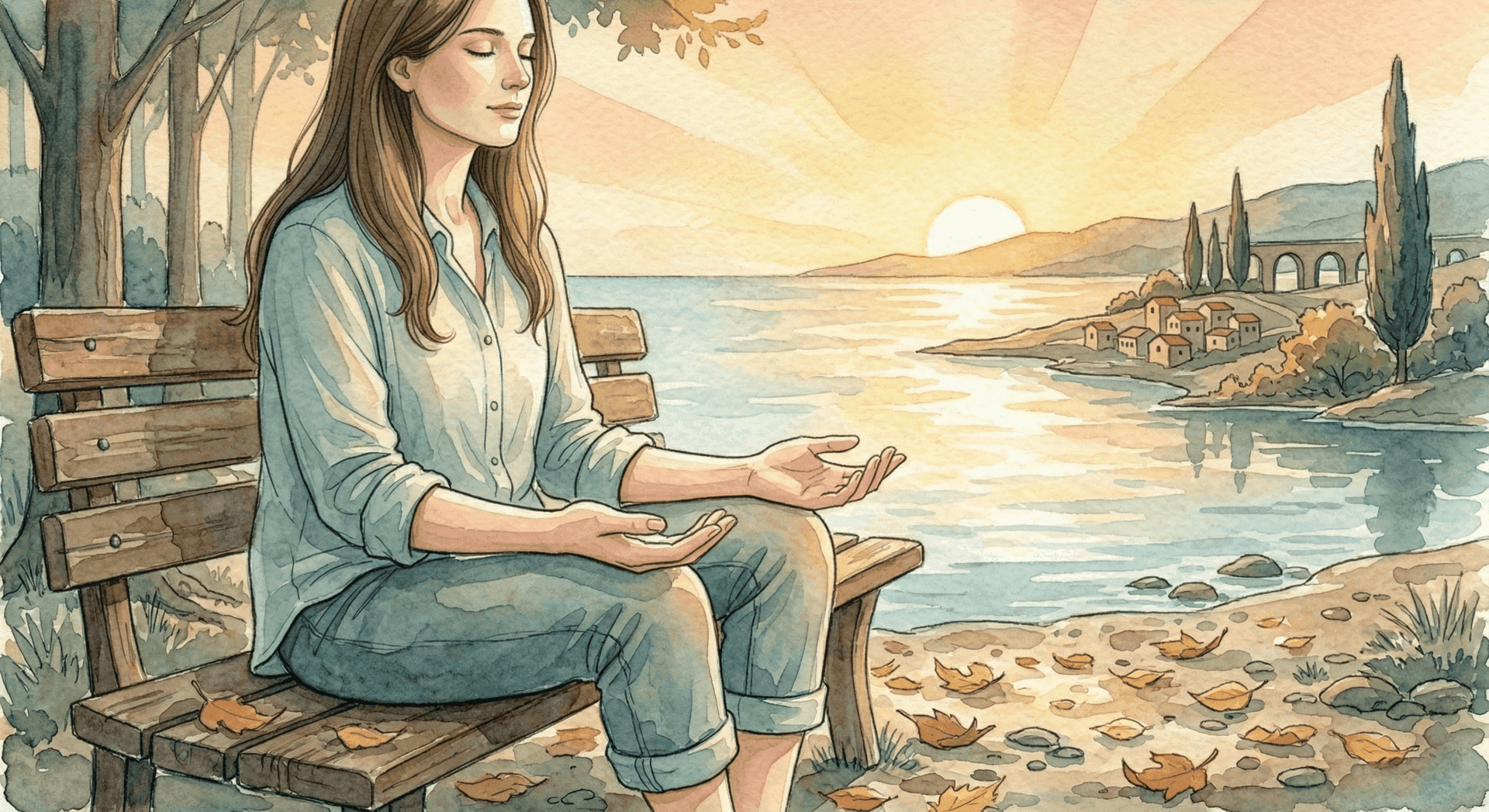
Willing Hands: what to do with your fists when you cannot fight
Willing Hands is a DBT posture that takes the fight out of your body when there is no fight to have: you unclench your fists and turn your palms up. Notice how your hands ball up when you are furious about something you cannot change? That grip keeps the anger topped up. Your brain reads hand position constantly, and clenched fists are the oldest signal there is for get ready. Open palms are the oldest signal for I am not armed. Turning them over gives your nervous system a different sentence to read, and it works from the outside in, so it does not need you to think clearly first. Marsha Linehan built it into Dialectical Behavior Therapy alongside half-smiling. What no single technique can tell you is whether it is the one your state needs right now - the coach in EmoFlow-AI picks that from your check-in and adapts it to your situation.
d = 0.20-0.25 - effect of facial expression on emotional experience across 138 studies (Coles et al., 2019).
3,878 participants across 19 countries in the 2022 Many Smiles Collaboration.
What Is This Technique?
Willing Hands is a distress tolerance skill from Dialectical Behavior Therapy, developed by psychologist Marsha Linehan in the 1990s. It runs on a two-way street between posture and feeling: what your body is doing changes what you feel, not only the other way round. Your brain checks the body for signs of trouble more or less continuously. Clenched fists evolved as preparation for fighting or holding a weapon. Open palms evolved as the universal way of saying there is nothing in my hands. When you open yours on purpose, you are telling yourself you are not defending against anything right now. Linehan paired this with half-smiling as the other half of the same idea - the hands take anger and resistance, the face takes the rest.
How Does It Work?
Your brain keeps a running read on where your body is, and hands take up an outsized share of that attention - far more than most other parts. So it hears your hands loudly. Clenched fists report back that trouble is coming, the alarm stays up, and the body keeps the stress chemistry flowing. Open hands report the opposite, and the side of you that can rest gets room. The best-tested version of this loop is the face: Coles et al. (2019) pooled 138 studies and found a small but reliable effect of expression on felt emotion (d = 0.20-0.25), and the Many Smiles Collaboration (2022, Nature Human Behaviour, 3,878 people across 19 countries) found it again - clearest when people took the position on purpose rather than having it put on them. That last detail is why this technique asks you to choose the posture. Hung and Labroo (2011) found that tightening muscles, fist clenching included, buys short-term willpower at the price of held tension. A web page starts from zero every time you open it and cannot know that you tried this yesterday and it did nothing; the coach in EmoFlow-AI remembers between sessions what worked and what you turned down, and it does not simply agree with everything. It is not a therapist and does not pretend to be.
Linehan (2015), DBT Skills Training Manual, Guilford Press - book, not a study; the source of the Willing Hands protocol.
Sources: Coles, N. A., Larsen, J. T., & Lench, H. C. (2019). A meta-analysis of the facial feedback literature. Psychological Bulletin, 145(6), 610-651. https://www.apa.org/pubs/journals/features/bul-bul0000194.pdf, Linehan, M. M. (2015). DBT Skills Training Manual (2nd ed.). Guilford Press - book., Porges, S. W. (2011). The Polyvagal Theory. Norton - book., DBT Skill Willing Hands: Embrace Acceptance and Find Calm. https://counselingcentergroup.com/dbt-skill-willing-hands/, Half-Smiling / Willing Hands, Now Matters Now. https://nowmattersnow.org/skill/half-smiling-willing-hands/
Step-by-Step Guide
- 1
Notice Your Current Hand Position
Find a comfortable position - sitting, standing or lying down all work. If sitting, rest your hands on your lap or thighs. Notice where your hands are right now without changing anything yet. Clenched? Gripping your phone? Balled up in your pockets? It is easy to carry a grip like that for hours without noticing. This bit takes five or ten seconds, and it matters because you are catching the pattern before you change it. Noticing turns an automatic thing into a choice.
- 2
Open Your Palms Upward
Turn your palms upward, facing the ceiling or sky. Let your fingers gently curl open - not stretched flat, not clenched, just softly relaxed. Your thumbs rest naturally, not pressed against your fingers. If standing, let your arms hang at your sides with palms facing slightly forward. The key is soft openness, not rigid positioning. If palms up feels too vulnerable (common for people with anxiety or trauma history), start with palms down but fingers unclenched. You can progress to palms up over time as the posture begins to feel safer.
- 3
Hold and Notice the Urge to Re-Clench
Hold the posture for 30 seconds to 2 minutes. Breathe naturally. You will likely notice the urge to re-clench - this is completely normal and expected. Each time you notice the urge, choose to re-open your hands. This repeated choosing IS the practice. You're not trying to force relaxation or manufacture acceptance. You're giving your nervous system a different signal and seeing what shifts. Some people feel a release in their shoulders or jaw as the hands stay open - tension patterns are connected throughout the body.
- 4
Add Half-Smile and Close the Practice
Optionally add Half-Smile - let the corners of your mouth turn slightly upward, not a forced grin, just a soft upturn. Relax your forehead and jaw. This combines acceptance signals through two channels: hands and face. After your practice, notice if anything shifted. You don't need to feel dramatically different. Even a slight decrease in the grip of anger or resentment counts. The effect builds with repetition. Practice when calm to build the neural pathway, so it's available automatically when you need it most.
When Should You Use This?
Use Willing Hands when you're stuck fighting something you cannot change. Specific situations include: sitting in traffic, gripping the steering wheel while blood pressure rises; replaying an argument at 2am with fists clenched under the covers; dealing with a boss who made a decision without consulting you; facing family criticism that triggers old patterns. The technique works best at intensity levels 4-7. At intensity 8+, pair it with extended exhale breathing or grounding first - your nervous system needs calming before acceptance becomes possible. Use it proactively too: a 60-second practice between work and home helps release accumulated tension before you walk through the door.
- Who this is for
- This one is for you if your hands do the arguing - the grip on the wheel, the fist under the duvet at 2am, the phone held like it owes you money. It suits anger you cannot spend: a decision made above your head, a person who will not apologise. Go gently if open palms feel exposing; palms down with loose fingers is a real version of this.
- When it fits in your week
- Stuck in traffic with your knuckles going pale on the wheel. Lying awake replaying an argument with your hands shut tight. In the car outside your own house after a day you have not put down yet. Reading the message you are not going to answer tonight. Any moment where your body is braced for a fight that will not happen.
- Why one pass is not enough
- One round shows you today. Whether the same grip comes back every Tuesday evening is only visible when several check-ins sit side by side, and that is what the journal in EmoFlow-AI builds out of them - your triggers over weeks, and what actually helps you rather than what should. A session you abandon halfway never enters that picture: only what you finish counts. How the AI coach spots your patterns over weeks
Sixty seconds, hands only
- 1Squeeze both fists as hard as you can. Five seconds. Harder than feels reasonable.
- 2Breathe out slowly through your mouth and let the fingers uncurl one at a time, in slow motion.
- 3Shake the hands loose from the wrists, twice.
- 4Turn the palms up, wherever they are - lap, table, armrest.
- 5Let the fingers stay softly curved. Not flat, not gripping.
- 6Three breaths. When the hands close again, open them again without commenting on it.
Worth asking afterwards
Not while you are holding it - after, when the hands are still open.
- 1
What were the fists getting ready for?
Sometimes there is a person in them, sometimes a deadline, sometimes something from years ago. The answer decides whether acceptance is the right tool here or whether a boundary is what is actually missing.
- 2
Did palms up feel like too much?
That reaction is information rather than failure. It tells you how defended you usually are. Palms down with loose fingers gets you most of the way, and you can move on from there in weeks, not minutes.
- 3
Where else was the bracing?
Jaw, shoulders, stomach, the back of the neck. Hands are only where it shows up fastest and where you can do something about it without anyone noticing.
- 4
What did not change?
The situation, almost certainly. That is the honest report. What is worth checking is whether the grip on it loosened, and how you could tell.
The short version
- Clenched fists keep anger supplied; open palms cut off one of its inputs. That is the whole idea.
- It works from the outside in, so it does not need you to think clearly first - which is why it is reachable when talking yourself down is not.
- Squeeze harder before you open. Muscles let go more completely from a peak than from halfway.
- Palms up can feel exposing, and that is common enough to plan for. Palms down with loose fingers is a legitimate version.
- This is built for anger and resistance. For anxiety the open posture sometimes adds to the exposure - if it does, use grounding instead.
When open hands are the wrong tool
The limits matter more here than the technique does, and two of them come up often.
- Palms up raises your alert instead of lowering it - work palms down, or use something else.
- The anger belongs to something still happening, and what is missing is a boundary rather than acceptance.
- You go blank or feel far from yourself while turning your attention inward.
- The resentment has been deciding how you sleep and how your days go for months - that is a conversation with a person, not an exercise.
- You notice urges to hurt yourself or someone else.
If you are thinking about harming yourself, no technique on this page is the right next step. Call a local emergency number or a crisis line and talk to a person.
Willing Hands is a starting point - your coach picks what actually fits
Reading about Willing Hands is one thing; doing it when you're overwhelmed is another. EmoFlow-AI starts with a feelings wheel to name what you're actually feeling among 130 emotions. Then a private AI coach - not you guessing or searching the web - chooses the practice that actually fits your check-in and your history, and walks you through it step by step, in the moment. It remembers what worked and builds a picture of your patterns over time. Not a chatbot that forgets you.
- Names what you feel among 130 emotions, then the coach picks the practice that fits - no guessing, no "which technique should I use"
- Walks you through it step by step, in the moment - not a static how-to
- Learns from your check-ins and history, remembers what worked, and shows your patterns
Free check-in, no account or card. Coaching is free to try for 3 sessions - nothing can auto-charge.
Start free check-inFor Mental Health Professionals
Willing Hands suits clients learning DBT distress tolerance, and it earns its keep between sessions rather than in the room. EmoFlow-AI supports that practice and records what the client cannot easily reconstruct a week later: which situations prompted it, the 0-10 intensity before and after, and whether it helped or did nothing. They can share that picture with you through one link, which gives you continuity without adding documentation to your own workload. The client decides what is shared and nothing moves without them. One thing worth raising early: for clients with a trauma history the palms-up position can read as exposure, and palms-down with unclenched fingers is the version to start from.
- Clients practice DBT skills between sessions with guided support
- Session prep reports show technique usage and effectiveness data
- Privacy-first: client controls all data sharing
Frequently Asked Questions
The simplicity is exactly what makes it work. Your body responds to posture on its own - there is no thinking to get right first. That two-way street between how you are sitting and how you feel is well documented. Coles and colleagues (2019) pooled 138 studies of facial feedback and found that changing the expression really does shift the feeling - a small effect, but a consistent one, and it asks for no change of mindset. The same principle applies to hands. You do not have to believe it will work. Just change the position and notice what happens over 30 to 60 seconds.
For acute anger or frustration, hold for 30-60 seconds or until you notice a shift. When practicing with breathing exercises, match it to your breathing cycles - open on exhale. For mindfulness practice, 5-20 minutes works well. For preventive maintenance, try 1-2 minutes two to three times daily. The duration matters less than consistency. Building the habit when you're calm creates a neural pathway you can access automatically when activated. Set phone reminders for "hand checks" throughout your day.
Feeling silly is common and fades with practice. Feeling vulnerable is actually important information - it tells you how defended you usually are. If palms up feels too exposed, start with palms down but fingers unclenched. Progress gradually. You can also hold something soft like a pillow while keeping your grip loose. For trauma survivors, the exposed position may trigger safety concerns. Start with cupped hands (as if holding something precious) and work toward open palms over weeks, not minutes.
Willing Hands is specifically designed for anger, resentment, frustration, and resistance - emotions that involve fighting against something. For anxiety, the open posture can sometimes feel too vulnerable and actually increase distress. If you have anxiety, try Willing Hands with eyes open and feet firmly grounded first. If it increases your sense of exposure, switch to grounding techniques or paced breathing instead. Half-Smile (the companion technique) works better for sadness and worry than Willing Hands does.
Helpful For These Emotions
Related Techniques
Ready to practice this technique?
Start a Check-in