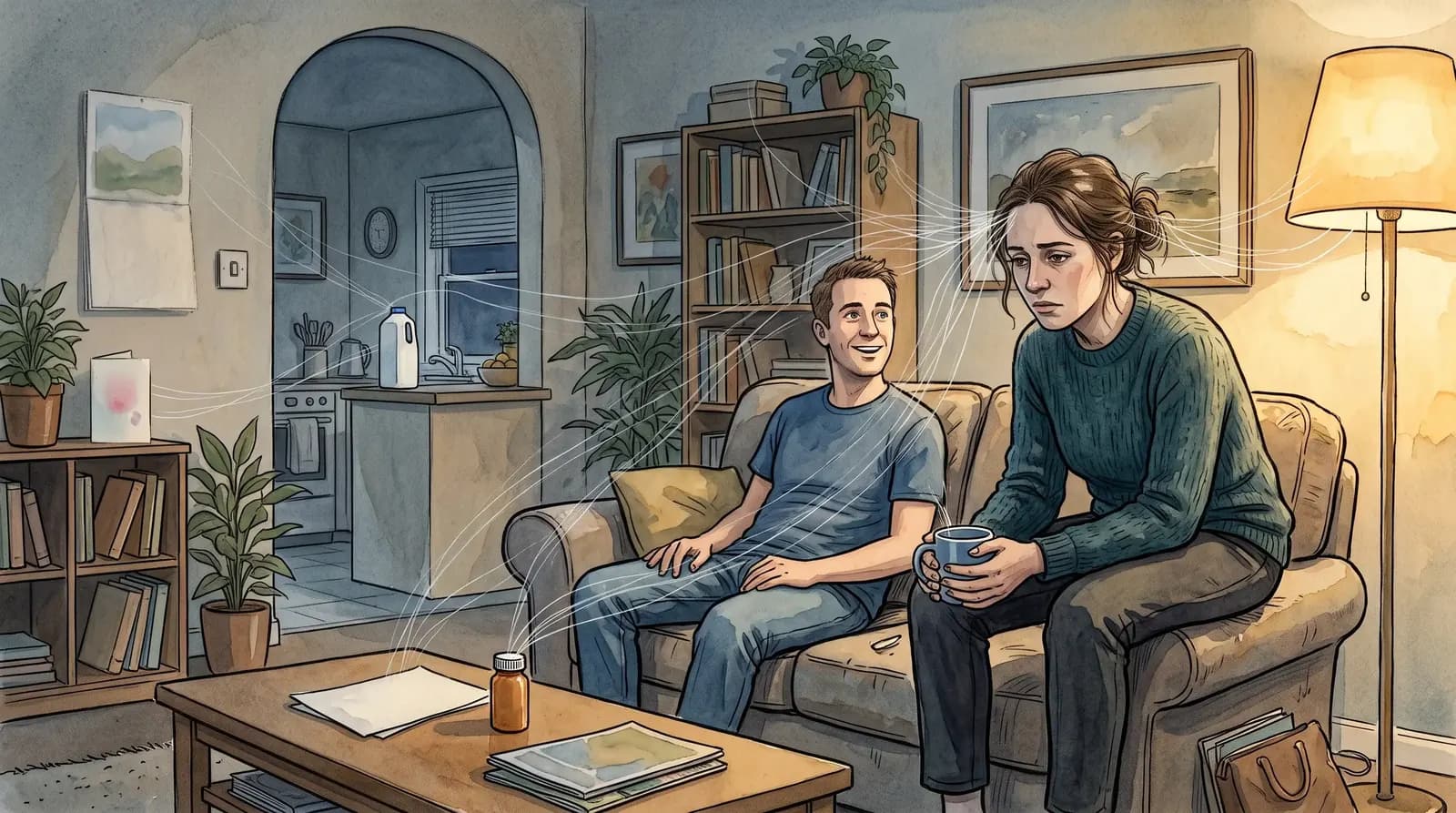
The Mental Load Nobody Sees - Including You
The mental load is the thinking half of running a life: noticing what is about to run out, working out the options, deciding, and then checking it actually got done. Sociologist Allison Daminger, who interviewed 35 couples, found the sting in it: this work is invisible to both the partner and the person carrying it. Which is why the tiredness never has a name. You did not do more today, you tracked more, and tracking leaves no evidence behind. Naming its effect on you is the part with nowhere to happen, and it is where EmoFlow-AI starts: a check-in on a wheel of 130 emotions turns "I'm just tired" into the specific thing, because from inside one exhausted evening resentment and worry feel identical.
10 more hours a week: the multitasking gap between mothers and fathers (Offer & Schneider, 2011)
70 interviews with members of 35 couples behind the four-part definition of cognitive labour (Daminger, 2019)
Try Our Interactive Feelings Wheel
130 emotions. AI-powered insights. Completely free.
Identify your emotions now
Try FreeYou are the one who remembers the permission slip is due Friday, his mother's birthday is coming, the last of the medicine went yesterday. Nobody sees you do it, because there is nothing to see. This is the invisible labor at home people call the mental load, and the research on it is unusually clear about one thing: it is not a personality trait and it is not you being bad at relaxing. It is a real kind of work with a real, measured cost. Below: the four parts it is made of, why splitting the chores does not touch it, and where you can move something without anyone else agreeing to it - your own state under all of it.
On this page
Why Doesn't He See the Mental Load?
How Do I Explain the Mental Load to My Partner?
Why Am I So Tired When I Haven't Done Anything?
How to Use
- 1
Write the invisible column, not the chore list
For one week, keep a note with two columns: what you did, and what you kept in your head. The second column is the one nobody has ever seen, including you. Anticipating and checking go there: noticing the shampoo is low, remembering the form, following up on whether the appointment got booked. A week is enough. You are not building a case against anyone, you are making a thing visible that has no shape until it is written down.
- 2
Name what the load is doing to you, in exact words
Once a day, stop for a minute and put a precise word on your state. Not "fine" and not "tired": try overlooked, resentful, on edge, flat, taken for granted. Putting a feeling into words measurably lowers its intensity - a quiet form of emotional regulation which works even though it does not feel like doing anything. Precision is the active part here. "Stressed" gives you nothing to act on; "resentful about being the only one who remembers" points straight at what has to change.
- 3
Hand over ownership of one thing, completely
Pick one recurring area and give away the whole loop, not the task: the noticing, the deciding and the checking. School emails. Anything to do with the car. Birthdays on his side of the family. Say plainly that you will not be tracking it. Then let it wobble, because the first few weeks usually do. If you step back in to check, the loop comes straight back to you and nothing has moved.
- 4
Look at a week, not at tonight
One bad evening tells you almost nothing. A week of small notes tells you when it spikes, what it lands on, and which handover actually held. That is the difference between feeling permanently overloaded and knowing that Sunday planning and Thursday logistics are the two hours that cost you most. You can negotiate about two hours. You cannot negotiate about a feeling.
Questions Worth Sitting With
Not a quiz, and there is no score at the end. This is self-reflection with a narrow aim: to find the specific thing under the general tiredness.
- 1
What did I remember today that nobody thanked me for?
Write down three. Small ones count, and small ones are usually the whole point.
- 2
Where does the resentment actually land?
Is it the task itself, or being the only one who knew it existed? Those two go in very different directions.
- 3
What would I have to let go badly for a month to hand it over for good?
The answer is usually the thing you have decided you are the only one who can do properly.
The Short Version
- The mental load is four things: anticipating, finding options, deciding, and checking. The anticipating and the checking are the ones that fall unevenly.
- It is invisible to the person carrying it too, which is why it goes unnamed for years.
- The measured cost is doubled-up hours: mothers multitask 10 hours a week more than fathers, and for them those hours come with more stress and distress.
- Splitting tasks does not touch it. Handing over a whole loop, including the noticing and the checking, does.
- Well-meaning partners keep an unequal split in place by treating it as an accident of schedules, without anyone deciding anything.
Four Things People Get Wrong About It
The mental load has been written about enough to collect its own folklore.
It just means women do more housework.
It is a separate layer from housework. You can have the chores split down the middle and still be the only one who notices when something is about to run out.
If he loved me more, he would see it.
The research finds it invisible to the person carrying it as well. Something you cannot see yourself is not a reliable test of anyone's love.
Just delegate more.
Delegating a task leaves the tracking with you: you still have to notice it is needed, ask, and check. Handing over the whole loop is what makes a difference.
It only counts if you have kids.
That is where the studies were done, with partnered mothers. The tracking work itself does not require children: it also shows up caring for an ageing parent, or living alone with a lot to run.
Research Evidence
Sources: Daminger, A. (2019). The Cognitive Dimension of Household Labor. American Sociological Review, 84(4). https://doi.org/10.1177/0003122419859007, Daminger, A. (2020). De-gendered Processes, Gendered Outcomes. American Sociological Review. https://doi.org/10.1177/0003122420950208, Offer, S., & Schneider, B. (2011). Revisiting the Gender Gap in Time-Use Patterns. American Sociological Review, 76(6). https://doi.org/10.1177/0003122411425170, Robertson, L. G., Anderson, T. L., & Hall, M. E. L. (2019). Mothers and Mental Labor. Psychology of Women Quarterly, 43(2). https://doi.org/10.1177/0361684319825581, Reich-Stiebert, N., Froehlich, L., & Voltmer, J.-B. (2023). Gendered Mental Labor: A Systematic Literature Review. Sex Roles. https://doi.org/10.1007/s11199-023-01362-0, Torre, J. B., & Lieberman, M. D. (2018). Putting Feelings Into Words: Affect Labeling as Implicit Emotion Regulation. Emotion Review, 10(2). https://doi.org/10.1177/1754073917742706, Lieberman, M. D., et al. (2007). Putting Feelings Into Words: Affect Labeling Disrupts Amygdala Activity. Psychological Science, 18(5). https://pubmed.ncbi.nlm.nih.gov/17576282/
Sources
- The Cognitive Dimension of Household Labor - Daminger, American Sociological Review (2019)
- Revisiting the Gender Gap in Time-Use Patterns - Offer & Schneider, American Sociological Review (2011)
- Mothers and Mental Labor: A Phenomenological Focus Group Study of Family-Related Thinking Work - Robertson, Anderson & Hall, Psychology of Women Quarterly (2019)
- Gendered Mental Labor: A Systematic Literature Review on the Cognitive Dimension of Unpaid Work - Reich-Stiebert, Froehlich & Voltmer, Sex Roles (2023)
- Putting Feelings Into Words: Affect Labeling Disrupts Amygdala Activity in Response to Affective Stimuli - Lieberman et al., Psychological Science (2007)
See Your Own Mental Load with EmoFlow-AI
Any tool for the mental load has one hard requirement: it must not become another task on your list. EmoFlow-AI is built around exactly this. You tap where you are on a feelings wheel of 130 emotions, pick several at once when it is mixed emotions rather than one tidy feeling, and set how strong it is and what is going on around it: bad sleep, overload, a conflict. There is no blank page waiting for you to explain yourself and no streak to keep alive. The journal writes itself from those taps, so your week has a shape even on the days you had nothing left for writing. It does not redistribute the housework, and nobody can honestly promise you it will. What it gives you is the missing piece: your own state, in words, on a page you can actually look at.
- A feelings wheel of 130 emotions with multi-select: for days of mixed emotions - resentment and guilt and relief at once, not one tidy label
- Intensity, context and life area in the same tap: how strong, on how little sleep, and whether this is family, work or the relationship
- The journal writes itself from your check-ins, so keeping it is not one more thing you have to remember
- Patterns across a week and a month: when the load spikes and what it actually costs you, which one hard evening can never show
- No streaks and no reminders, on purpose: this is a place to put things down, not another list to keep up
For Mental Health Professionals
Clients rarely arrive naming the mental load. They arrive with irritability, flat exhaustion that sleep does not fix, and a relationship complaint that sounds like it is about chores. Daminger's four-part model, anticipating, identifying options, deciding, monitoring, gives a usable frame for separating what is unequal from what is not, and Daminger's later work is useful with couples who are genuinely egalitarian in belief and unequal in practice. This page is written so a client can read it between sessions and come back with specifics rather than a general sense of unfairness.
- A vocabulary for the invisible parts of household work that a client can use with a partner
- Findings a client can read for herself, which is often what makes the complaint feel legitimate to her
- Daily check-ins she can bring to a session instead of reconstructing the week from memory
Frequently Asked Questions
The mental load is the thinking work: remembering, anticipating, planning, checking. Emotional labor, in everyday use, is the managing of feelings, keeping the peace, softening bad news, tracking everyone's mood. In practice they arrive together, usually in the same person, which is why the terms get used as if they were one thing. The distinction is worth keeping when you are trying to explain what you carry: they land on you differently and they get handed over differently.
Yes, and the paper-and-pen version works: a two-column note for a week, then a conversation about handing over whole loops. What a solo run genuinely gives you is a snapshot of a week you were paying attention. What it does not give you is repetition. One week can show you that Sunday is heavy; whether it is heavy every Sunday, or whether it eased after the handover, only shows up when several check-ins sit next to each other, which is exactly what people stop doing once the hard week ends. That is the honest limit, and it is a limit of memory, not of willpower.
Start with what changes without anyone else agreeing to anything. Naming your state in precise words lowers its intensity, which is small but real and immediate. Then look for the one loop that can be handed over completely rather than the ten tasks that cannot. And be honest about the arithmetic: if nothing at all can be handed over, the load is not a self-management problem, and the conversation to have is about the arrangement itself, not about coping better inside it.
The common ones people report: tiredness that sleep does not touch, irritability that arrives out of proportion to whatever set it off, forgetting things you never used to forget, dreading Sunday evening, feeling flat about things you used to like. Parental burnout is a real and separate condition, with exhaustion, emotional distance from your children and a sense of being a different parent than you used to be, and it is worth naming honestly with a professional rather than absorbing as normal tiredness.
It is where the evidence is concentrated, because that is who researchers studied: mostly partnered mothers in the US and Europe. The work itself does not require children. Anyone who is the household's default noticer carries it, including people caring for parents, people living alone with a lot to run, and men in households where they hold that role. What the research does say clearly is that when the tracking work is unequal, it is usually the woman doing more of it.
Related Techniques
EmoFlow-AI provides evidence-based education - not medical advice, diagnosis, or treatment - and is not a substitute for a qualified mental-health professional. If you are in crisis or may harm yourself, contact local emergency services or a crisis line now.
Ready to try the interactive feelings wheel?
Start a Check-in