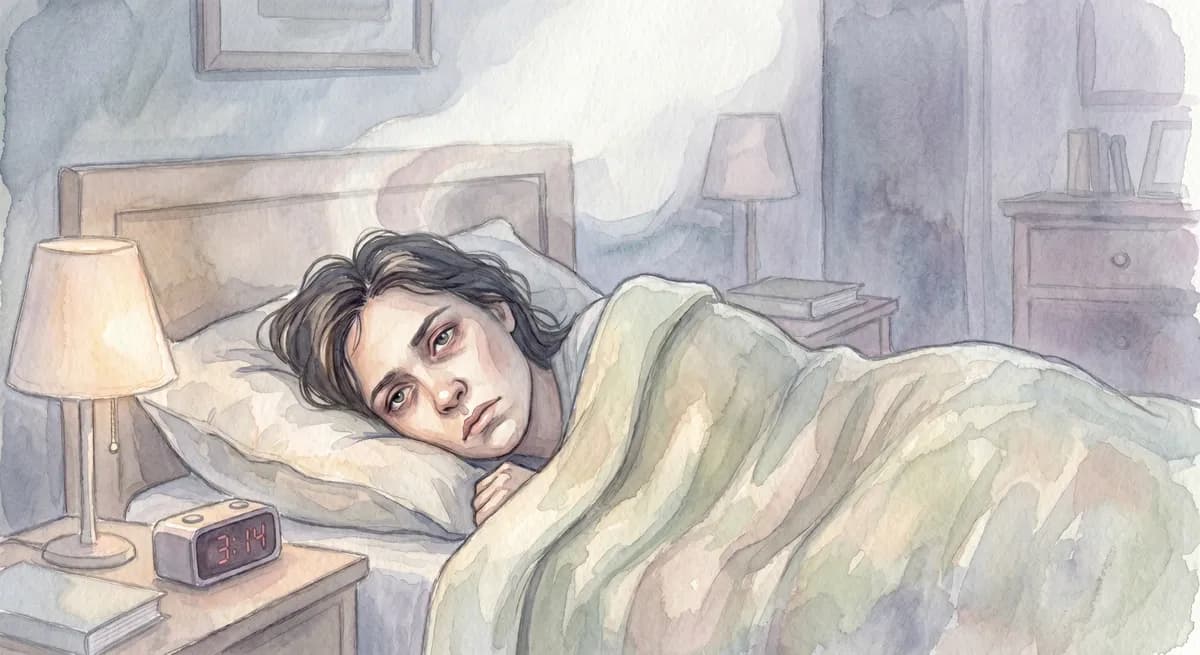
Why Can't I Relax Even When Calm?
Feeling wired but tired, unable to relax even when nothing is wrong, usually means the nervous system stays in alert mode long after the stressful thing is gone. In a Stanford study, just 5 minutes a day of slow, sigh-style breathing lowered stress and lifted mood over a month, more than meditation did (Balban et al., 2023), so the body's calming brake still works. This wired-but-tired pattern is not a flaw, laziness, or ingratitude. Picture sitting down to watch a show with your jaw clenched and shoulders up by your ears, mind already racing through tomorrow's list. That is a learned pattern, and patterns can shift. This guide helps you understand, in plain language, why you can't relax when life is fine, and gives you simple body-first practices to try tonight to finally settle down.
Feeling it right now? Start here
- 1Make every out-breath longer than your in-breath: in through the nose for 4, out slow through the mouth for 6 to 8, for six rounds. The long exhale is what signals your body to settle.
- 2Do one round of cyclic sighing: breathe in through your nose, take a second small sip of air to top off, then one long sigh out through the mouth. Even a minute lowers the dial.
- 3Look slowly around the room and name 5 things you see, 4 you hear, 3 you can touch. You are showing your body, out loud, that there is no threat right now.
- 4Drop your shoulders and unclench your jaw on purpose - that is where the always-on tension hides - and notice the small release.
5 minutes a day of slow, sigh-style breathing over 1 month lowered stress and improved mood more than meditation (Balban et al., 2023, Stanford)
Review of 223 studies found deliberately slowing breathing nudges the body toward rest (Laborde et al., 2022)
Try Our Interactive Feelings Wheel
130 emotions. AI-powered insights. Completely free.
Identify your emotions now
Try FreeBeing wired but tired means your body runs in alert mode while you sit still, even when life is calm. Clinicians sometimes call the underlying state chronic hyperarousal: a nervous system that stays switched on long after the stressful thing is over. It is not a disorder you caught, and it is not a weakness. It is a learned pattern. Think of your body as having an accelerator that revs you up for action and a brake that lets you rest. When life is stressful for a long stretch - work, money, caregiving, old fears - the accelerator gets used so much that it stops fully letting off. So your body keeps acting as if there is a threat when there isn't one. That is why you feel tense for no reason, can't switch off your mind, or feel oddly on edge in a safe room. The wired feeling is not in your head, and it is not a sign you are doing life wrong.
On this page
Why does your nervous system stay on alert after the stress is gone?
Why does your mind keep hunting for the next problem when nothing is wrong?
When should you reach for these body-first practices?
How to Use
- 1
Breathe out longer than you breathe in
Sit or lie down. Breathe in through your nose for about 4 counts, then out slowly through your mouth for 6 to 8, so the out-breath is clearly longer than the in. The long exhale is the part that tells your body to settle, so don't rush it. Do this for about 5 minutes. If counting feels fussy, skip it and just make every out-breath slow and soft, like you are fogging a mirror or sighing with relief. Notice your shoulders start to drop and your jaw loosen as you go.
- 2
Try the double-inhale reset (cyclic sighing)
When you want to come down fast, do this. Breathe in through your nose, then take a second small sip of air through your nose to top off your lungs. Then let one long, slow breath out through your mouth until you are empty. Two inhales, one long sigh out, then repeat for 1 to 5 minutes. Even one minute lowers the dial noticeably. Done a few minutes daily, this also slowly lowers your overall edginess, so it works both in the moment and over time.
- 3
Tense and release to show your body it's safe
Starting at your feet, squeeze the muscles tight for about 5 seconds, then let go all at once and notice the looseness for 10 seconds. Work your way up the body: feet, calves, thighs, belly, hands, arms, shoulders, jaw, face. Shoulders and jaw hide most of that always-on tension, so do not skip them. This takes about 10 minutes and is a good one right before sleep. It helps most when your body stays braced even though your mind keeps insisting everything is fine.
- 4
Look around and name what's safe
Stop and let your eyes wander the room. Don't force it; let your gaze land where it wants for a few seconds. Then name 5 things you can see, 4 you can hear, 3 you can touch, 2 you can smell, and 1 you can taste. You are showing your brain, out loud, that right here, right now, there is no threat. Reach for this when your mind races or hunts for the next problem, or when you feel uneasy for no clear reason. The whole thing takes about a minute and pulls you out of your head and back into the room.
- 5
Hum, sigh, or splash cold water for a quick reset
No time or privacy for a full routine? Pick one fast option. Hum a low, steady tune for 30 to 60 seconds, because the buzz in your throat and chest nudges your body's calm switch. Or let out a few audible sighs, dropping your shoulders a little more each time. Or splash cool water on your face, or hold something cold against your cheeks, for 15 to 30 seconds. These work at a desk or in the car when you just need to take the edge off and can't do anything longer.
5 Questions to Find Your Pattern
You do not have to answer all of these. Pick the one that lands and sit with it for a minute. There are no right answers, only what you notice.
- 1
When am I most wound up, and is there actually a problem?
Notice when in your day or week the tension peaks. Is there a real issue at that moment, or just the habit of being braced? Most wired-but-tired tension is a pattern tied to certain times and places, not a present danger. Spotting the when tells you exactly when to reach for a practice, before it builds.
- 2
Where does the tension live in my body?
Right now, scan for it. Jaw, shoulders, chest, stomach? Tension you can name is tension you can aim a practice at. A quick tense-and-release on that one spot, or a hand resting there with a few slow breaths, gives the held stress somewhere to go instead of just sitting there quietly draining you.
- 3
Does part of me feel I should be doing something?
When you try to rest, listen for the voice that says you should be productive, or that letting your guard down isn't safe. That is rest guilt or bracing, not the truth. Naming it - this is a learned belief, not an emergency - loosens its grip just enough to let you actually sit still and breathe.
- 4
What does my mind reach for when things go quiet?
The moment it goes still, what what-if shows up? Then ask the honest question: is that thing actually happening right now? Usually it isn't. Catching the next-problem habit in the act lets you set the thought down and come back to the room, instead of chasing one worry into the next.
- 5
Which one small practice could become a daily ritual?
Pick the single body-based practice that felt easiest, even two minutes of slow exhales. Small and regular beats big and rare. Attach it to something you already do, like sitting down after work, so it becomes a clock-out ritual that lowers your baseline before the tension has a chance to pile up.
A Worked Example: Maya Can't Switch Off at Night
Here is how the practices fit together in a real evening, instead of in theory.
Nothing here required Maya to force herself to relax. She named the feeling, settled her body first, and used what she learned about her own pattern to head off the tension next time.
Wired but Tired vs an Anxiety Disorder
Everyday wired-but-tired is a common pattern you can often reflect on and work with on your own. An anxiety disorder is worth a professional's help. Here is how to tell them apart - and if you are unsure, a doctor or therapist can help you sort it out.
| Wired but tired (common) | Anxiety disorder (see a pro) | |
|---|---|---|
| How long it lasts | Comes and goes; tied to certain times, places, or busy stretches | Present most days for weeks or months, hard to shake whatever you try |
| Effect on daily life | Annoying and draining, but you still work, sleep okay-ish, and function | Disrupts sleep, work, relationships, or eating in a way you can't push through |
| Response to simple practices | Slow exhales, grounding, and tense-and-release take the edge off | Body practices barely touch it, or the worry feels uncontrollable and constant |
| Extra signals | Tension, racing mind, restlessness, rest guilt | Panic attacks, dread, avoidance, physical symptoms, or thoughts of self-harm |
| What usually helps | Body-first self-help practices and noticing your own pattern | Assessment and support from a doctor or therapist, sometimes alongside self-help |
When to Reach Out for Professional Support
Body-first self-help and reflection take the edge off everyday wired-but-tired. But some signs are worth bringing to a doctor or therapist - and asking for help early is a strength, not a failure.
- The tension is constant for weeks and the simple body practices barely touch it
- It is wrecking your sleep, your focus, or your ability to function day to day
- You feel dread, panic attacks, or like you are always waiting for something bad to happen
- You are avoiding people, places, or tasks to keep the anxiety down
- You are leaning on alcohol, substances, or other habits to switch off
- If you take medication for anxiety or sleep, talk to your prescriber before changing anything
If you have thoughts of harming yourself, contact a crisis line or emergency services now. EmoFlow is not an emergency service.
Research Evidence
Sources: Balban et al. (2023) - Cyclic sighing can help breathe away anxiety (Stanford Medicine) - https://med.stanford.edu/news/insights/2023/02/cyclic-sighing-can-help-breathe-away-anxiety.html, Laborde et al. (2022) - Effects of voluntary slow breathing on the autonomic nervous system (Neuroscience & Biobehavioral Reviews) - https://pubmed.ncbi.nlm.nih.gov/35623448/, University of Rochester Medical Center - 5-4-3-2-1 coping technique for anxiety - https://www.urmc.rochester.edu/behavioral-health-partners/bhp-blog/april-2018/5-4-3-2-1-coping-technique-for-anxiety, Upper East Side Psychology - When your nervous system is stuck on: understanding chronic hyperarousal - https://www.uppereastsidepsychology.com/post/when-your-nervous-system-is-stuck-in-on-understanding-chronic-hyperarousal
Sources
- Cyclic sighing can help breathe away anxiety (Balban et al., 2023) - Stanford Medicine
- Effects of voluntary slow breathing on the autonomic nervous system (Laborde et al., 2022) - Neuroscience & Biobehavioral Reviews
- 5-4-3-2-1 coping technique for anxiety (University of Rochester Medical Center, 2018) - University of Rochester Medical Center
- When your nervous system is stuck on: understanding chronic hyperarousal (Upper East Side Psychology) - Upper East Side Psychology
Make Your Hidden Tension Visible with EmoFlow-AI
The hard part about being wired but tired is that it is invisible. Nothing is obviously wrong, so you brush it off and stay stuck. EmoFlow-AI is a private reflection and mood tracker built around a feelings wheel, made to turn that hidden baseline tension into something you can name. Each quick check-in, instead of typing fine, you tap the under-the-surface feeling on a wheel of 130 emotions - restless, braced, on-guard - and naming the exact thing already loosens the alarm a little. Then you slide an intensity from 1 to 10. Here is the smart part, and it is not a generic chatbot improvising feel-good replies: EmoFlow runs on concrete algorithms and validated, research-based practices. At 8 or above it routes you to grounding or slow exhale breathing first, because at high alert only body practices reach the brake; at 4 to 7 it adds reflection tools. Instead of vaguely trying to relax, an in-the-moment coach walks you through 80+ practices one step at a time, no remembering required. And after a couple of weeks, pattern tracking surfaces YOUR triggers - most wired on Sunday nights, right after closing the laptop - so you can make sense of emotional overwhelm and the day-to-day work of how to relieve stress and anxiety, all kept private.
- Feelings wheel of 130 emotions to name vague tension (restless, braced, on-edge) instead of just fine
- Intensity slider with body-first routing - grounding and slow exhale breathing first at 8+, reflection tools at 4 to 7
- Pattern tracking that surfaces when and where you're most wired and which practices settle you
For Mental Health Professionals
Chronic hyperarousal often hides behind a vague complaint of being stressed, tense, or unable to switch off, and clients struggle to report it because the wired baseline just feels like normal life. EmoFlow-AI gives you between-session reflection data on when a client is most activated: the times of day, the situations, and the intensity levels they would otherwise never notice. Clients practice slow-exhale breathing, cyclic sighing, tense-and-release, and grounding with step-by-step guidance, so they arrive having actually tried the practices and journaled around them rather than only discussing them. Because settling the body is a skill that builds with reps, small structured daily reflection between sessions can support the work. With the client's consent, a simple PDF report brings their real week into the room, so you can tailor the work to their actual triggers instead of guessing.
- See a client's real activation patterns and intensity levels between sessions
- Clients arrive having practiced breathing and grounding, not just talked about them
- Optional PDF reports turn I just feel tense all the time into specific, workable detail
Frequently Asked Questions
Because your nervous system can stay stuck in alert mode long after the stress is gone, a pattern clinicians call chronic hyperarousal. Your body has an accelerator and a brake; after a long stretch of stress, the accelerator stops fully letting off, so your body keeps acting as if there is a threat when there isn't. That is the wired-but-tired feeling. It is not a flaw or ingratitude, just a learned pattern, and the brake still works. You reach it through the body: slow out-breaths, releasing tight muscles, and showing your senses you are safe right now.
Tension you can't explain often means your nervous system is stuck on high alert, holding stress you have not had a chance to release or even notice. Clinical writing describes feeling tense for no clear reason as the body acting as if there is a threat when there isn't one, which is a pattern, not a personal failing. The tension usually hides in your shoulders, jaw, chest, or stomach. A tense-and-release pass through those spots, or a few minutes of slow breathing, gives that held stress somewhere to go. If it is constant and wearing you down, it is worth raising with a doctor or therapist too.
Because your body can't tell a real danger from a worried thought, so a mind trained to stay braced will fill any quiet by scanning for the next problem. Solve one worry and another what-if pops up; that is the next-problem habit, not a sign something is actually wrong. The fix is not to win the argument in your head. Show your senses you are safe instead: look slowly around the room and name what you see, hear, and touch. Grounding pulls your attention out of the loop and back into the present, which quiets the alarm within a minute or so.
Being on edge with no clear cause usually means a part of you is quietly bracing for something to go wrong, so it won't let you fully lower your guard. After a long stretch of stress, that braced state can become your nervous system's default, acting as if a threat is coming even in a safe room. It is a pattern, not a flaw. Body-first practices work best here: slow exhales and the double-inhale reset (cyclic sighing) signal safety faster than any pep talk. A review of 223 studies found that deliberately slowing your breathing nudges the body toward rest (Laborde et al., 2022).
If you learned somewhere that being busy equals being safe or worthy, then stillness can feel wrong rather than relieving; that is rest guilt. The moment you stop, a part of you whispers that you should be doing something, or that letting your guard down isn't safe. This is common, and it is a learned belief, not the truth about rest. Start small so it feels less threatening: two minutes of slow breathing counts. Naming it helps too - telling yourself this is rest guilt, not a real emergency - which loosens its grip enough to let you actually sit still.
You reach the brake through the body, not by thinking harder. Three practices do most of the work: long slow out-breaths (out longer than in) for about 5 minutes, tense-and-release through your shoulders and jaw where tension hides, and grounding by naming what you see, hear, and touch right now. In a Stanford study, 5 minutes a day of slow, sigh-style breathing lowered stress and improved mood over a month (Balban et al., 2023). Small and regular beats big and rare, so a couple of minutes daily slowly lowers your baseline edginess over weeks.
Related Techniques
Related Articles
EmoFlow-AI provides evidence-based education - not medical advice, diagnosis, or treatment - and is not a substitute for a qualified mental-health professional. If you are in crisis or may harm yourself, contact local emergency services or a crisis line now.
Ready to try the interactive feelings wheel?
Start a Check-in