Emotional Outbursts: Why You Lose Control and How to Stop
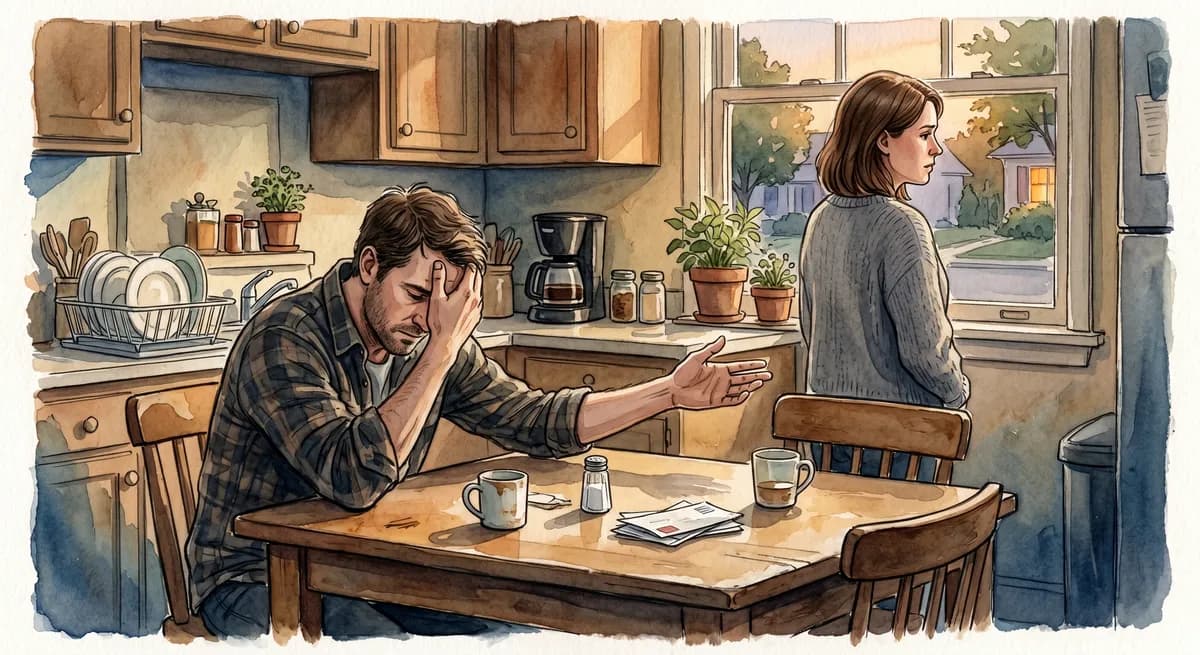
Emotional outbursts are sudden, out-of-proportion reactions where a feeling, usually anger, takes over faster than the thinking brain can catch up, so you snap and then drown in regret. The cause is physical, not a character flaw: a small alarm in the brain called the amygdala fires and briefly crowds out the reasoning part behind your forehead. Psychologist Daniel Goleman named this an amygdala hijack (Goleman, 1995), and it is exactly why just calm down feels impossible mid-blow-up. If you go from calm to furious in seconds and say things you would never say with a clear head, you are not broken and you are not a bad person. The blow-up is rarely about the thing in front of you; it is usually pressure that built up all day. This guide explains, in plain language, why you lose control and a few practices you can try tonight to notice the snap before it lands.
Feeling it rising right now? Start here
- 1Get to a sink and splash cold water on your face, or hold a cold wet cloth over your cheeks and eyes for 30 seconds. The cold tips your body toward calm fast.
- 2Breathe out longer than you breathe in: in for 4, out for 8, six rounds. The long exhale is what switches the alarm off.
- 3Say one honest sentence and step away: I am really agitated, give me a minute, it is not about you. Then ride out the next 90 seconds without feeding it.
- 4Put the feeling into one word in your head: furious, hurt, overwhelmed. Naming it quietly turns the volume down.
Putting a feeling into words lowered activity in the amygdala, the brain's alarm (Lieberman et al., 2007, UCLA)
An emotion's chemical surge floods through and clears in about 90 seconds if you do not keep feeding it (Bolte Taylor, 2008)
Try Our Interactive Feelings Wheel
130 emotions. AI-powered insights. Completely free.
Identify your emotions now
Try FreeAn emotional outburst is when a feeling, usually anger, takes over so fast and so hard that you act before you can think. One small comment, and you are shouting, slamming a door, or saying something cruel you will regret in five minutes. It feels like something else takes the wheel, because in a sense it does. Emotional outbursts are not a character flaw or proof that you are too much. They are a sign that your emotional alarm system is firing faster than your thinking brain can step in. Everyone has this wiring. For some people the alarm is just more sensitive, or it goes off when the tank is already full. Sudden, out-of-proportion anger that you cannot reason your way out of is far more common, and far more human, than the shame afterward makes it feel. Understanding what an outburst is, and noticing what set it off, is the first step toward catching it earlier.
On this page
What happens in your brain during an emotional outburst?
When should you reach for these emotional-outburst practices?
Why do you snap hardest at the people you love?
How to Use
- 1
Splash cold water on your face (the fastest off-switch)
When you feel the heat rising and your head has stopped working, get to a sink. Splash cold water on your face, or hold an ice cube or a cold wet cloth against your cheeks and around your eyes for about 30 seconds. Cold on the face triggers a built-in reflex that slows your heart and tips your body toward calm almost instantly. This is not a metaphor. It is physical. That cold shock buys you the few seconds you need to not say the thing you will regret.
- 2
Breathe out long and slow (4 in, 8 out)
Breathe in through your nose for a count of 4. Then breathe out, even slower, through your mouth for a count of 8. The long out-breath is the part that matters, because it signals your body to switch the alarm off. Do 5 or 6 rounds. Do not try to solve anything yet, do not rehearse your comeback, just keep the exhale longer than the inhale. Slow breathing with a long out-breath lowered heart rate and blood pressure within minutes in a small trial of 43 adults (Vierra et al., 2022).
- 3
Name the feeling in one word
Quietly put the feeling into a single word: I am furious, this is hurt, I am overwhelmed. Naming it turns down the brain's alarm and switches the thinking part back on. One UCLA study found that simply labeling an emotion lowered activity in the amygdala (Lieberman et al., 2007). You can say it out loud to the other person too: I am really agitated right now, give me a minute, it is not about you. Catch it early, while you can still find the word, to keep a 3 from becoming a 9.
- 4
Wait out the 90 seconds
Remind yourself of one fact. The chemical surge of an emotion floods through your body and clears in about 90 seconds, as long as you do not feed it with more angry thoughts (Bolte Taylor, 2008). Step away. Set a timer on your phone if it helps. Ride it out by watching the feeling in your body, the hot chest, the tight jaw, instead of replaying the story of who did what. After roughly 90 seconds the peak passes and you get your choice back. The trick is not feeding the fire while you wait.
- 5
Notice the build-up before it becomes an outburst
Outbursts are pressure that has piled up, so the real shift happens hours earlier. Once or twice a day, check in: how full is my tank, 1 to 10? Am I tired, hungry, lonely, behind on everything? When you notice you are already at a 7, protect yourself before the overflow. Eat something, rest, lower what you are asking of yourself, or warn the people around you that you are running low. You cannot blow up from empty if you refill before it spills over.
What an Outburst Is Telling You
A big feeling is rarely random noise. It usually carries a message worth reading once you are calm. Here is how clinicians often read a few of the feelings tangled up in an outburst. Treat these as gentle prompts to reflect on, not diagnoses.
A Worked Example: Maya After a Brutal Day
Here is how the practices fit together in a real moment, instead of in theory.
Nothing here required Maya to never feel angry. She just learned to spot the hijack, settle her body before trying to think, name the real feeling under the anger, and use what she saw to notice the build-up earlier next time.
When to Reach Out for Professional Support
Self-reflection practices help many people notice and soften their outbursts, but some patterns deserve a professional's support. Consider reaching out to a therapist or doctor if you notice any of these.
- Outbursts are frequent, intense, and out of proportion to what set them off, and they keep happening despite your efforts.
- Your anger has led to threats, broken objects, or physical aggression toward people or yourself.
- Outbursts are damaging your relationships, your job, or how you feel about yourself.
- You feel out of control of your emotions most days, or the guilt afterward is turning into lasting shame or hopelessness.
- If you take medication, talk to your prescriber before making any changes.
If you have thoughts of harming yourself, contact a crisis line or emergency services now. EmoFlow-AI is not an emergency service.
Research Evidence
Sources: Goleman (1995) - Emotional Intelligence (amygdala hijack) - https://www.healthline.com/health/stress/amygdala-hijack, Lieberman et al. (2007) - Putting Feelings Into Words (Psychological Science, UCLA) - https://pubmed.ncbi.nlm.nih.gov/17576282/, UCLA Health - Putting feelings into words produces therapeutic effects in the brain - https://www.uclahealth.org/news/release/putting-feelings-into-words-produces-therapeutic-effects-in-the-brain-ucla-neuroimaging-study-supports-ancient-buddhist-teachings, Psychology Today - The 90-Second Rule Builds Self-Control (Bolte Taylor) - https://www.psychologytoday.com/us/blog/the-right-mindset/202004/the-90-second-rule-builds-self-control, Vierra et al. (2022) - Slow breathing lowers heart rate and blood pressure - https://pmc.ncbi.nlm.nih.gov/articles/PMC9277512/, Gottman Institute - The Anger Iceberg - https://www.gottman.com/blog/the-anger-iceberg/
Sources
- Goleman (1995), Emotional Intelligence - the amygdala hijack, the brain's alarm taking over before the thinking brain can step in - Healthline
- Lieberman et al. (2007), Putting Feelings Into Words - labeling an emotion lowered amygdala activity - Psychological Science (UCLA)
- Bolte Taylor (2008), My Stroke of Insight - an emotion's chemical surge clears in about 90 seconds if you do not feed it - Psychology Today
- Vierra et al. (2022) - slow breathing with a long exhale lowered heart rate and blood pressure - PMC (National Library of Medicine)
EmoFlow-AI Helps You Notice the Blow-Up Before It Lands
The hardest part of an emotional outburst is timing. By the time you realize you are losing control, your thinking brain is already offline and no journaling prompt can reach you. EmoFlow-AI is a private reflection and emotion-journaling tool built around that exact problem, and it is not a generic chatbot improvising feel-good replies. It runs on concrete algorithms and research-based practices. When you are flooded and mark a high intensity, EmoFlow does not hand you a thinking exercise you cannot use. Its intensity routing offers a body-first practice like cold water, long exhales, or grounding to settle your nervous system first, then an in-the-moment coach walks you through it step by step, and the thinking practices come once you can think again. That is the order a hijacked brain needs. Because anger is usually a cover, the 80+-emotion wheel lets you name the real feeling underneath, the hurt, fear, or shame, which is how you start to understand anger outbursts at the source instead of just clamping the lid. A 20-second check-in catches the pressure at a 4 or 5, hours before things tip over, and after a handful of check-ins EmoFlow's pattern tracking shows your real triggers, tired evenings, certain people, an empty stomach, so you can refill the tank on purpose and notice what to do when anger takes over.
- Emotion wheel that helps you name the real feeling under the anger, whether it is hurt, fear, or shame
- Intensity routing that offers cold water and slow breathing first at 8+, then reflection practices when you are calmer
- Pattern tracking that surfaces your personal triggers so you notice the build-up before the outburst
For Mental Health Professionals
Clients who present with anger or emotional outbursts often cannot report what tips them over, because in the moment it just feels like the situation in front of them. EmoFlow-AI gives you between-session reflection data on the real pattern: the times of day, the intensity levels, and the build-up that precedes a blow-up, the hunger, exhaustion, and stress that load the system before the trigger. Clients practice the body-first reflections, cold water, paced breathing, and naming the feeling, plus the tank check-in with step-by-step guidance, so they arrive having actually tried the practices, not just discussed them. With the client's consent, a simple PDF report brings their real week into the room, so you can tailor anger and emotion-awareness work to their specific triggers rather than generic advice.
- See a client's real outburst triggers and intensity patterns between sessions
- Clients arrive having practiced cold water, paced breathing, and naming the feeling, not just talked about them
- Optional PDF reports turn a vague bad week into specific, workable detail
Frequently Asked Questions
Because of a real, physical event called an amygdala hijack. Your brain's alarm, the amygdala, senses a threat and floods your body with stress chemicals faster than the thinking part of your brain can step in (Goleman, 1995). For a few seconds your emotional brain runs the show, so you act before you can weigh the cost. The regret only arrives once the chemicals drain and your thinking brain comes back online. It is not weakness or a lack of willpower. It is wiring everyone has. What helps is settling your body first, before you try to reason your way out.
Usually because the small thing is not really the cause. It is the last drop in an already-full tank. Emotional outbursts are pressure that has been building all day: skipped meals, poor sleep, stress, a hundred tiny frustrations stacking up. When you are already at a 7, it only takes a minor trigger to push you to a 10. That is why you can explode over a dirty dish and feel baffled by your own reaction afterward. Noticing the build-up earlier, by checking how full your tank is once or twice a day, is what softens the 0-to-100 jump.
First, know why it happens. You snap hardest at the people closest to you because you feel safe enough to drop the mask you held all day. That is not an excuse, but it does point to what helps. Notice the build-up early so you are not arriving home already at a 9, and use a body-first step the moment you feel the heat rising: cold water on your face, a few long exhales, or stepping out for 90 seconds. Then repair afterward. A simple I am sorry I snapped, that was about my day, not you protects the relationship and breaks the guilt cycle.
The guilt you feel after an emotional outburst is actually a good sign, because it means your values are intact and you care about the person you snapped at. The regret is your thinking brain coming back online and registering the gap between how you acted and who you want to be. The trap is letting that guilt curdle into shame, I am a terrible person, because shame makes the next outburst more likely, not less. Treat the guilt as a cue to repair and to look at what filled your tank, not as proof you are broken. Apologize, then get curious about the build-up.
Because in the moment, the part of your brain that knows it is irrational has gone quiet. During an amygdala hijack, the thinking, reasoning part of your brain behind your forehead is briefly shut out while your emotional alarm runs the show (Goleman, 1995). Knowing something is irrational lives in the thinking brain, which is exactly the part that is offline. That is why just calm down is useless mid-hijack. What works is going through the body, not the mind: cold water, a long slow exhale, a short break. Once your body settles, the reasonable part comes back, and so does your sense of control.
Easing emotional outbursts as an adult comes down to two timeframes. In the moment, settle your body before you try to think: splash cold water, breathe out long and slow, or step away for the 90 seconds it takes the chemical surge to pass (Bolte Taylor, 2008). Earlier, notice the pressure before it builds by checking your tank once or twice a day and refilling it, eat, rest, lower demands, when you are running low. It also helps to name the real feeling under the anger, since hurt and fear often hide there. If outbursts are frequent and hurting your relationships, that is a sign to reach out to a therapist.
Related Techniques
Related Articles
EmoFlow-AI provides evidence-based education - not medical advice, diagnosis, or treatment - and is not a substitute for a qualified mental-health professional. If you are in crisis or may harm yourself, contact local emergency services or a crisis line now.
Ready to try the interactive feelings wheel?
Start a Check-in