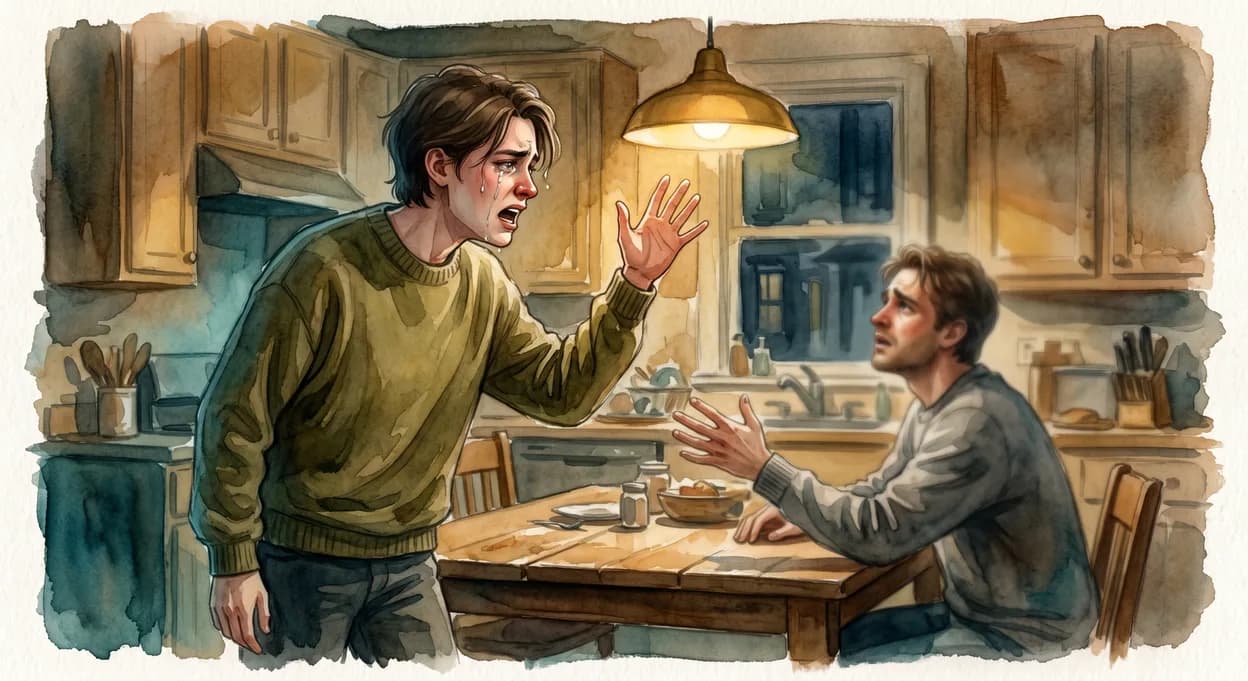
Why Your Reaction Isn't Your Real Feeling
Your reaction often isn't your real feeling. The anger, the snapping, the going cold - that surface reaction is frequently a secondary emotion sitting on top of a more vulnerable primary one like hurt, fear, or shame (Greenberg, Emotion-Focused Therapy, APA). That's a big part of why you "overreact" or feel so emotional: the loud feeling is guarding a tender one underneath. But here's the honest other half - heightened reactivity isn't always a hidden wound. Run on four hours of sleep and your emotional brain literally overreacts, with the amygdala showing amplified responses and the prefrontal "brake" weakening (Yoo et al., 2007, Current Biology). Sometimes you're not broken, you're depleted. The useful skill is pausing long enough to ask which one it is today - and naming the real feeling precisely, because that's what turns the heat down.
After sleep deprivation, amygdala reactivity to negative events was amplified and the prefrontal-amygdala connection was disrupted - the emotional brain overreacts and the regulating brain pulls back (Yoo et al., 2007, Current Biology).
Putting a feeling into words lowered amygdala activity and raised right ventrolateral prefrontal cortex activity in an fMRI study (Lieberman et al., 2007, UCLA).
Try Our Interactive Feelings Wheel
130 emotions. AI-powered insights. Completely free.
Identify your emotions now
Try FreePrimary and secondary emotion is the distinction that makes "why am I so emotional" finally make sense. Leslie Greenberg, who founded Emotion-Focused Therapy, separates a primary emotion (your first, true response to what happened) from a secondary emotion (a reaction to that primary feeling that covers it). Anger is the textbook cover: it hands you energy and a sense of control, while the hurt or fear underneath leaves you exposed. Nico Frijda added that every emotion carries a built-in urge to act - fear pulls you to withdraw, anger to push back (Frijda, The Emotions, 1986). So the reaction you notice is the urge on the surface, not the need beneath it. This article maps that everyday experience of overreacting onto real affective science - and stays honest that the feeling you show isn't always hiding a deeper one.
On this page
Why Is Your Reaction Often a Secondary Emotion Covering a Primary One?
Why Do I Get So Emotional When I'm Not Even Wounded?
How Does Naming the Real Feeling Turn the Intensity Down?
How to Use
- 1
Catch the reaction and pause on the impulse
Start the moment you notice a reaction that feels too big for the trigger - you snapped, went cold, or wanted to bolt. Before you explain it or act on it, pause and name the impulse: do you want to attack, withdraw, or freeze? That urge is a clue, not a verdict. Anger's impulse to fight often sits on hurt; the freeze impulse often hides fear or overwhelm. Just notice a reaction fired and that it's pointing at something underneath.
- 2
Ask whether you're wounded or just depleted
Before assuming a hidden feeling, run the honest check this whole topic turns on. Ask: how did I sleep, when did I last eat, how full is my plate this week, where am I in my cycle? If you're running on four hours of sleep and an empty stomach, the reaction may be plain depletion (Yoo et al., 2007), not a buried wound - and the move is rest, food, and self-kindness, not deep analysis. Both can be true on different days. This step keeps you from catastrophizing a tired Tuesday into a crisis.
- 3
Look for the feeling underneath the reaction
If it's not just depletion, ask the central question: if this reaction were armor, what would it be protecting? Anger frequently guards hurt or helplessness; numbness can cover grief; irritation can mask disappointment. This is the hardest part to do alone, because naming a feeling you can't yet see is exactly where solo reflection stalls. Try the test: imagine the loud reaction is gone - what raw feeling is left? That softer, more vulnerable emotion is usually the primary one, and it's the one worth reaching.
- 4
Name the underlying feeling in one exact word
Once you sense what's beneath, label it precisely - not "bad" or "upset," but the specific word: abandoned, ashamed, powerless, unseen, let down. Precision is the active ingredient, because putting a feeling into exact words lowers amygdala activity and brings the thinking brain back online (Lieberman et al., 2007). Most people stop at "angry" and miss the real signal. If no single word fits, list three near-misses and circle the closest. This high-resolution naming is what actually loosens the feeling's grip.
- 5
Step back and choose one wise next move
Shift into an observer stance: say "I notice hurt is here," not "I am furious," which creates a little distance so you can think instead of just react. Then ask what the real feeling needs. If it's hurt, maybe you say the tender thing instead of the sharp one; if it's fear, maybe you name it out loud; if it's depletion, maybe you stop and rest. One small, honest step beats fighting the surface reaction. Over time, watch what keeps recurring - the pattern is the real signal about your life.
What a Big Reaction Often Covers
Read these as tentative clues, not diagnoses - sometimes the reaction is exactly what it looks like, and sometimes it's just a tired, hungry, overloaded day. The skill is pausing to check, then naming the specific feeling underneath.
5 Questions to Catch the Feeling Under a Reaction
You don't need all five. Pick one after a reaction that felt too big, and keep your answers short and plain - this is self reflection, not an essay.
- 1
Am I wounded right now, or just depleted?
Before digging for a hidden feeling, check the basics: sleep, food, stress load, where you are in your cycle. If you're running on empty, the reaction may be plain depletion (Yoo et al., 2007), and the answer is rest, not analysis. This question alone stops a lot of needless spiraling.
- 2
If this reaction were armor, what would it be protecting?
Anger often guards hurt or helplessness; numbness can cover fear. Imagine the loud reaction gone, and notice what raw feeling is left underneath. That softer feeling is usually the primary one - the real target, and the thing worth naming.
- 3
What is the most exact word for what I feel?
Push past "bad" or "so emotional" to the specific: abandoned, ashamed, powerless, unseen, let down. Precision is what loosens a feeling's grip (Lieberman et al., 2007). If no single word fits, name three near-misses and circle the closest to the truth.
- 4
Can I say 'I notice this feeling' instead of 'I am this feeling'?
Try "I notice hurt is here" rather than "I am furious." That small shift to observer language creates a little distance, which lets you reflect on a hard feeling without being swept into it - and choose a wiser next move.
- 5
Have I felt this exact thing before, and when?
Look for the pattern. Does this reaction cluster around certain people, times, or situations - or around no-sleep days? Spotting what recurs, not any single moment, is what turns scattered noticing into real self-knowledge and emotional growth over time.
Myths About Being So Emotional
Your reaction is your real feeling - if you're angry, you're just angry.
The reaction is often a secondary emotion covering a more vulnerable primary one - anger over hurt, numbness over fear (Greenberg, Emotion-Focused Therapy). The real signal is the feeling underneath, when there is one.
Every reaction hides a buried feeling, so overreacting means unresolved trauma.
Not always. Sometimes anger is just anger, and reactivity often comes from ordinary causes - poor sleep (Yoo et al., 2007), stress load, hunger, hormonal cycles. Sometimes you're not wounded, you're depleted.
Being this emotional means I have a disorder or emotional instability.
Feeling extra-emotional under load is normal and human; it is not, by itself, a clinical diagnosis. Persistent, distressing dysregulation that disrupts daily life is a separate case worth a professional - that's different.
If I just label it 'anger,' that's enough.
Naming the specific underlying feeling - not the coarse one - is what turns intensity down (Lieberman et al., 2007; Barrett et al., 2001). "So emotional" is too blurry to act on; "let down" or "ashamed" gives you something to work with.
I should suppress the reaction and just calm down.
The useful move is the opposite: name what's underneath, which calms it, rather than fight the surface reaction. The reaction is information, not a malfunction to shut off.
The Reaction You Show vs the Feeling Underneath
| Secondary reaction (what you show) | Primary feeling (what's underneath) | |
|---|---|---|
| Anger / snapping | A surge of energy and control that feels safer to show | Often hurt, helplessness, or fear it's guarding |
| Going cold / shutting down | Withdrawal, silence, "I'm fine" | Often fear, overwhelm, or sadness too exposed to voice |
| Irritation over small things | Quick friction at things that shouldn't matter | Often disappointment - or plain depletion (no sleep, full plate) |
| What it carries | The urge to act (attack, withdraw, freeze) | The actual information and the real need |
| What helps | Fighting or suppressing it usually doesn't | Naming it precisely lowers its grip (Lieberman et al., 2007) |
When to Reach Out for Professional Support
Occasional big reactions and emotional days are normal. The picture is different when it's persistent and disruptive.
- Heightened emotionality is persistent and distressing - not the occasional bad day - and it disrupts your daily life, work, or relationships.
- Your reactions feel out of your control more often than not, or leave you ashamed or frightened afterward.
- Low mood, anxiety, or reactivity has lasted for weeks and isn't lifting with rest and basic self-care.
If you have thoughts of harming yourself, contact a crisis line or emergency services now. EmoFlow-AI is a reflection tool, not a diagnosis, not treatment, and not an emergency service.
Research Evidence
Sources: Greenberg, Emotion-Focused Therapy (APA, 2010/2015); Frijda, The Emotions (Cambridge, 1986), Lieberman et al., Psychological Science (2007), DOI 10.1111/j.1467-9280.2007.01916.x, PMID 17576282; Yoo et al., Current Biology (2007), PMID 17956744, Barrett et al., Cognition & Emotion (2001), DOI 10.1080/02699930143000239; Kashdan et al., Current Directions in Psychological Science (2015), DOI 10.1177/0963721414550708
Sources
- Putting Feelings Into Words: Affect Labeling Disrupts Amygdala Activity in Response to Affective Stimuli — Lieberman et al., Psychological Science (2007)
- The Human Emotional Brain Without Sleep - A Prefrontal Amygdala Disconnect — Yoo, Gujar, Hu, Jolesz & Walker, Current Biology (2007)
- Knowing What You're Feeling and Knowing What to Do About It: Mapping the Relation Between Emotion Differentiation and Emotion Regulation — Barrett, Gross, Christensen & Benvenuto, Cognition & Emotion (2001)
- Unpacking Emotion Differentiation: Transforming Unpleasant Experience by Perceiving Distinctions in Negativity — Kashdan, Barrett & McKnight, Current Directions in Psychological Science (2015)
- Putting Feelings Into Words: Affect Labeling as Implicit Emotion Regulation — Torre & Lieberman, Emotion Review (2018)
Catch the Feeling Under Your Reaction With EmoFlow-AI
Here's the honest problem when you overreact or feel so emotional: alone, you have to guess whether anger is covering hurt or you're just running on no sleep - and which technique would even help while you're flooded. EmoFlow-AI is built to be the guided, in-the-moment version of that, not a journaling app and not therapy. You start with a quick check-in on the interactive wheel of 130 emotions, naming the surface feeling precisely instead of stopping at "bad" or "so emotional" - the high-resolution labeling the research links to loosening a feeling's grip. Then the mismatch engine does the part you can't do alone: when your impulse (the urge to attack, withdraw, freeze) doesn't fit the emotion you named, it surfaces the likely primary feeling underneath - offered as a gentle, tentative hypothesis like "the anger might be guarding something tender," never a verdict you have to accept. From there an in-the-moment coach walks you through one fitting technique step by step, running on real algorithms and validated practices rather than a generic chatbot. And because analysis updates after each saved check-in, EmoFlow-AI shows which reactions keep recurring - whether anger keeps masking hurt on Sunday nights or you're simply reactive on no-sleep days - so your self reflection compounds into real emotional growth. Understanding primary and secondary emotion stops being a guess and becomes something you can see.
- Mismatch engine: when your impulse doesn't fit your stated emotion, it surfaces the likely primary feeling under the reaction - a tentative hypothesis, not a diagnosis
- 130-emotion wheel: names the precise feeling (affect labeling), moving you off the blurry "so emotional" to the exact word that loosens its grip
- In-the-moment coach: walks you through one fitting technique step by step on real algorithms, including when the honest answer is depletion, not a hidden wound
- Pattern tracking: updates after each saved check-in and shows which reactions keep recurring, so you learn your own pattern
For Mental Health Professionals
Clients frequently arrive saying they "overreact" or are "too emotional" without language for what sits underneath, which makes between-session reflection stall at vague self-blame. EmoFlow-AI gives them a structured way to practice it: the 130-emotion wheel supports precise affect labeling, and the mismatch engine flags when a secondary reaction (anger, withdrawal, numbness) appears to be masking a more vulnerable primary emotion - useful raw material for emotion-focused, CBT, or ACT-informed work. The honest multi-cause framing also nudges clients to check ordinary drivers like sleep and stress load before assuming a deep wound, which reduces catastrophizing. Clients can bring a dashboard or PDF of recurring emotional patterns into session, so you see which feelings, triggers, and reactions keep surfacing instead of relying on recall, and the client controls exactly what they share. It is a reflection bridge between sessions, not a replacement for clinical judgment, and it does not diagnose. If a client is in crisis, EmoFlow-AI routes to professional support and is not an emergency service.
- Between-session affect labeling that surfaces recurring secondary-over-primary patterns for review in session
- Mismatch detection that flags a likely hidden primary emotion under a client's surface reaction
- A pattern dashboard or PDF the client can choose to share, supporting emotion-focused and CBT work
Frequently Asked Questions
Overreacting to small things usually means a surface reaction is covering a more vulnerable feeling, and you're only seeing the cover. In Emotion-Focused Therapy, a secondary emotion like anger reacts to and hides a primary one like hurt or fear (Greenberg, Emotion-Focused Therapy). The small trigger often touches something tender underneath, so the reaction looks out of proportion to it. But not always - sometimes overreacting just means you're depleted from poor sleep, hunger, or stress (Yoo et al., 2007). The move is to pause, check whether you're wounded or just running on empty, then name the real feeling if there is one.
Feeling so emotional "for no reason" usually has a reason that isn't a hidden wound - it's often physical and ordinary. Poor or short sleep amplifies the emotional brain's reactivity while weakening the prefrontal brake that normally steadies you (Yoo et al., 2007, Current Biology). Accumulated stress, hunger, hormonal cycles, and plain depletion do the same, lowering your threshold for everything. So being more emotional under load is normal and human, not automatically a disorder. That said, if it's persistent, distressing, and disrupting your daily life, that's worth talking to a professional about. EmoFlow-AI is a reflection tool, not a diagnosis.
A primary emotion is your first, true response to what happened - sadness at a real loss, fear at a real threat - and it carries the actual information and need. A secondary emotion is a reaction to that primary feeling that covers it up (Greenberg, Emotion-Focused Therapy). The classic example is anger masking hurt: anger gives energy and control, while the hurt underneath feels too exposed to show. So the reaction you express isn't always the feeling you have. Understanding primary and secondary emotion is the key to overreacting - the work is reaching past the secondary reaction to the primary feeling it's guarding.
Snapping at people you love is one of the clearest examples of a secondary emotion in action. The people closest to you are where you feel most exposed, so when something touches a tender spot - feeling unseen, hurt, or afraid - anger often steps in as armor because it feels safer than the soft feeling underneath (Greenberg, Emotion-Focused Therapy). The snap protects you from the vulnerable feeling. Depletion makes it worse: tired and overloaded, your emotional brain reacts faster and your brake works less (Yoo et al., 2007). Catching the impulse and naming what's really there - hurt, fear, exhaustion - is what breaks the pattern.
Being emotional, or overreacting sometimes, is part of being a normal human under load - it is not, by itself, evidence of a mood disorder or "emotional instability." Reactivity rises with ordinary things like poor sleep, stress, and hunger (Yoo et al., 2007), and everyone has more emotional days. The separate, genuine case is when heightened emotionality is persistent, distressing, and disrupts your daily life or relationships over weeks - that's worth a doctor or mental-health professional, not because you're broken, but because support helps. EmoFlow-AI offers reflection and a tentative read of what's underneath, never a diagnosis.
Start by getting specific, because precision is what makes naming work. People who tell their feelings apart finely - "let down," not just "bad" - regulate better than those who lump everything into one blurry "so emotional" (Barrett et al., 2001; Kashdan et al., 2015), and putting a feeling into exact words lowers its intensity at the brain level (Lieberman et al., 2007). Try this: notice the reaction, imagine it gone, and ask what raw feeling is left underneath. Name that in one exact word. EmoFlow-AI's 130-emotion wheel is built for this, and its mismatch engine offers a gentle guess at the feeling under your reaction when your impulse doesn't fit your label.
Related Techniques
Related Articles
EmoFlow-AI provides evidence-based education, not medical advice, diagnosis, or treatment, and is not a substitute for a qualified professional. If you are in crisis or may harm yourself, contact local emergency services or a crisis line now.
Ready to try the interactive feelings wheel?
Start a Check-in