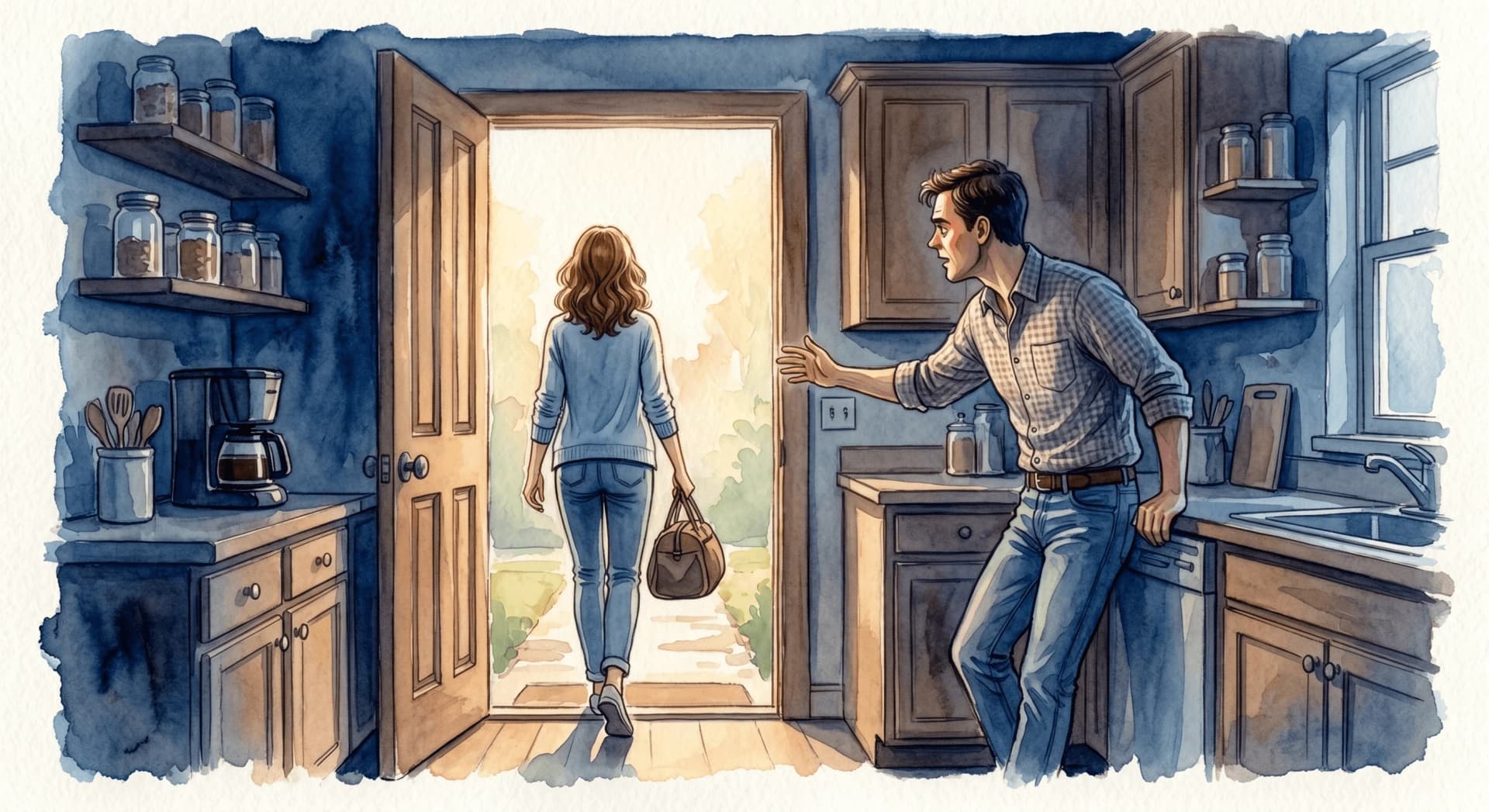
No Contact Protocol: A Tough Recovery Tool
No Contact is the single most recommended tool in narcissistic abuse recovery communities - and consistently one of the hardest to implement. The difficulty isn't weakness. It's neurochemistry. Manipulative relationships create trauma bonds through intermittent reinforcement. Dutton and Painter (1993), studying women who had left abusive partners, found that a power imbalance plus unpredictable rather than constant abuse produced the strongest attachment to the person causing the harm. On top of that, the ongoing stress keeps cortisol elevated and the craving cycle running, so contact feels necessary even when you know it isn't. No Contact is not the silent treatment, not a game, and not punishment. It's a structured recovery protocol that interrupts all five processes that maintain harm: it ends ongoing manipulation access, allows the nervous system to de-escalate from chronic hypervigilance, weakens the trauma bond through time and distance, clears the cognitive confusion that gaslighting requires ongoing contact to sustain, and creates the stability that self-concept needs to begin rebuilding. The hardest part isn't the decision. It's the hoover - the manipulator's attempt to regain access - and the guilt that arrives immediately after you protect yourself.
Breaking no contact multiple times before it sticks is the documented norm in trauma bond recovery, not failure - survivor community data consistently shows most people break NC at least once before achieving sustained separation
In women who had left abusive partners, a power imbalance combined with intermittent rather than constant abuse predicted the strongest attachment to the abuser (Dutton & Painter, 1993)
What Is This Technique?
No Contact (NC) is a boundary protocol that ends all voluntary communication with a toxic, abusive, or manipulative person. It is not temporary space, not 'cooling off,' and not a tactic to make them miss you. It's a recovery tool: complete cessation of voluntary contact that creates neurobiological conditions for healing. Low Contact (LC) is the adapted version for situations where complete avoidance is impossible - co-parenting, shared workplaces, family events. LC minimizes interaction to essential logistics only, with strict emotional boundaries and documented communication. Both versions are built around the same principle: your healing requires removing the source of ongoing harm. Closure is not a prerequisite for No Contact - in fact, the desire for 'one last conversation' is often the manipulator's most effective entry point for re-engagement. Closure comes from within, not from them. They cannot give it, because their goal is maintaining access, not helping you heal.
How Does It Work?
Manipulative relationships maintain their hold through five simultaneous mechanisms that ongoing contact sustains. Trauma bonding (Dutton & Painter, 1993): the intermittent reinforcement pattern requires continued contact to maintain the craving cycle. Cognitive confusion: gaslighting is an active, ongoing process that requires you to keep engaging with the gaslighter's version of reality. Nervous system dysregulation: chronic cortisol elevation from relationship stress keeps the body in a state of hypervigilance that can't resolve while the stressor is present. Identity erosion: the manipulator's installed beliefs about who you are continue to be reinforced by each contact. Hope cycling: each interaction reactivates hope ('maybe this time') that prevents reality from setting in. No Contact interrupts all five simultaneously. Van der Kolk's research in 'The Body Keeps the Score' (2014) documents how the nervous system cannot heal while continuing to process threat. Removing the threat source is not optional for recovery - it's the condition for it.
van der Kolk, B. (2014). The Body Keeps the Score: Brain, Mind, and Body in the Healing of Trauma. Viking (book)
Arabi, S. (2017). Becoming the Narcissist's Nightmare. [No contact protocols for narcissistic abuse recovery] (book)
Sources: Violence and Victims, 8(2), 1993 - Dutton & Painter traumatic bonding. doi:10.1891/0886-6708.8.2.105, The Body Keeps the Score - van der Kolk, 2014 (book), BIFF: Quick Responses to High-Conflict People - Eddy, 2014 (book)
Step-by-Step Guide
- 1
Get Clear on Your Why
Write down specifically why you're implementing No Contact. Not 'because they're terrible' - that won't hold when you're lonely at 2am and the hoover arrives. Specific: which behaviors affected your health, sleep, work, self-concept, other relationships, ability to function. What did the relationship cost you, concretely? How did you feel consistently after contact? Write two or three specific incidents that represent the pattern. This document serves as your anchor when doubt and guilt arrive - and they will. When you want to break NC, read this first. The reasons that are true today will still be true when you're in withdrawal and they're suddenly being kind. Keep this somewhere you can access it quickly.
- 2
Define the Boundary Completely
No Contact means: no calls, no texts, no emails, no direct messages on any platform, no in-person contact, no checking their social media profiles, no asking mutual friends about them, no responding to any form of outreach including emergencies they create to regain access. Anything less is contact. The most common partial-NC mistakes: blocking their main number but leaving one platform open; muting instead of blocking on social media; maintaining contact with mutual friends who serve as information relays; responding to 'emergency' messages; checking their profiles without interacting. Each exception keeps one channel of nervous system activation open. If complete NC is impossible (co-parenting, shared workplace), define exactly what Low Contact means: which topics, which communication methods, what you will and won't respond to.
- 3
Block and Remove Strategically
Block on every platform you share: phone (including WhatsApp/Telegram/Signal), all social media, email if possible (filter to a folder you never open), any apps you share access to. Archive photos - don't delete them if you might need them for legal purposes, but move them out of your daily view. Remove or box up physical reminders from your living spaces - not because the memories aren't real, but because daily visual triggers extend the grief cycle unnecessarily. If you share a physical space, plan your routines to minimize likelihood of encounter. Inform people you trust that you won't be accepting messages through them. The infrastructure of NC is practical: it removes the low-effort pathways that the trauma bond impulse will use the moment you're vulnerable.
- 4
Plan for the Hoover
They will attempt to re-engage. This is not speculation - it's the documented pattern in abuse recovery literature (Arabi, 2017; Durvasula, 2019). The hoover comes in forms designed to target your specific vulnerabilities: sudden apologies, claims they've changed or started therapy, fabricated or real emergencies, gifts or gestures, messages through mutual friends, new numbers after you've blocked the old one, or creating crises that appear to require your involvement. Plan your responses now, while you're clear-headed, not in the moment when you're triggered: 'I will not respond to texts from unknown numbers.' 'I will hang up if I hear their voice.' 'I will not meet to have a conversation.' 'I will not respond to third-party messages.' Write these down. The hoover's effectiveness depends on catching you off guard. Anticipating it removes that advantage.
- 5
Build Your Support Structure
Tell the people you trust what you're doing and why, to the degree you're comfortable. Ask them specifically not to serve as message relays - not to pass along information about you, and not to pass along messages from the person you've cut contact with. Identify who you'll call when the urge to break NC is overwhelming: not someone who will tell you 'just text them,' but someone who understands why you're doing this and will help you stay the course. Online support communities (r/narcissisticabuse, r/raisedbynarcissists) can supplement in-person support - people who have done this themselves know what Week 1 feels like. A therapist who specializes in trauma or abuse recovery is the most valuable resource for NC, because the feelings that NC produces - grief, guilt, withdrawal, relief, confusion - are all real and need somewhere to go.
- 6
Make Space for the Grief
No Contact includes grief. Grief for the relationship. Grief for the person you thought they were. Grief for the future you imagined. Grief for the good moments that were real even inside a harmful dynamic. This grief is not evidence you made the wrong decision - it's evidence you cared, and that caring was real regardless of what they were. Don't rush this grief or interpret it as 'maybe I should go back.' Many people returning to contact are seeking relief from the grief of NC rather than because the relationship was actually good. Name it precisely - grief, loneliness, guilt, relief, anger, or some combination - because each one means something different and asks for something different. The mood tracker builds a record of how your emotional state shifts over weeks of NC. That record is your evidence of healing happening even when it doesn't feel like it.
When Should You Use This?
No Contact planning is appropriate at intensity 2-6, when you have enough cognitive access to make and implement a structured decision. Use it when you're ready to commit, or when you want to understand the protocol so you can prepare. Not appropriate at high intensity (7+) where major decisions may be impaired - stabilize first. For physical abuse, stalking, custody situations, or shared finances, professional support (domestic violence services, legal counsel) is essential alongside or before NC. NC is not the right tool for ordinary difficult relationships with reasonable people - that calls for boundary-setting or communication skills. The question is whether the relationship is toxic and whether distance is something you can choose.
- Who this is for
- For you if you have gone no contact and keep breaking it, or you are trying to decide whether to start. It is for the hardest version too: a parent, a sibling, someone you share children with. You do not have to be certain, and you do not have to call it forever to start today.
- When it fits in your week
- The evening his name comes up and your thumb is already moving. The eleventh day, which is usually worse than the second. The hour after he suddenly texts something kind after weeks of nothing. The family dinner where everyone asks. The Sunday you have written a message six times and deleted it six times.
- Why one pass is not enough
- You can hold a boundary for three weeks and still not see that the urge always lands on the same day, after the same thing, when you are tired in the same way. That only shows up in notes kept over time - and in someone who can pick up the phone at the hour you would otherwise be texting him.
The urge is here right now
- 1Set a timer for twenty minutes and do not decide anything until it ends. The urge rises and falls; you are trying to outlast a wave, not win an argument.
- 2Write the message in full. All of it, unsent, in your notes. Most of what you need is the writing, not the sending.
- 3Move: stairs, the length of the street and back, cold water on your wrists and face.
- 4Call the person on your list. Not to discuss whether to text him - just to talk for ten minutes about anything else.
- 5If you broke it, note the time and what came before it. Then start today's count from now. There is no version of this where you go back to zero as a person.
Five lines to keep
- It is protection, not punishment. It works even when he never learns anything from it.
- Breaking it is data, not failure: what happened in the hour before is the part worth knowing.
- The urge to check on him is withdrawal from an unpredictable reward, and unpredictable rewards are the hardest kind to stop (Dutton & Painter, 1993).
- Kindness after silence is the most dangerous moment of the whole thing. Nothing has changed because a nice message arrived.
- With children, courts, or shared money, full silence is not the tool. Limited, written, businesslike contact is.
When this needs a person, not a page
No contact is a boundary, not a safety plan, and it is not a diagnosis of anybody. Some of this needs professionals.
- He is following you, showing up, or contacting your family and workplace after you asked him to stop.
- There are children, custody, or shared money involved - that needs legal advice before silence.
- You have been hurt physically or threatened. The weeks around leaving are the most dangerous ones.
- You cannot eat or sleep, or you are having thoughts of not wanting to be here.
If you are in danger right now, call your local emergency number. In the US you can call or text 988, or reach the National Domestic Violence Hotline at 1-800-799-7233. This page is for reflection; it is not an emergency service.
No Contact is a starting point - your coach picks what actually fits
Reading about No Contact is one thing; doing it when you're overwhelmed is another. EmoFlow-AI starts with a feelings wheel to name what you're actually feeling among 130 emotions. Then a private AI coach - not you guessing or searching the web - chooses the practice that actually fits your check-in and your history, and walks you through it step by step, in the moment. It remembers what worked and builds a picture of your patterns over time. Not a chatbot that forgets you.
- Names what you feel among 130 emotions, then the coach picks the practice that fits - no guessing, no "which technique should I use"
- Walks you through it step by step, in the moment - not a static how-to
- Learns from your check-ins and history, remembers what worked, and shows your patterns
Free check-in, no account or card. Coaching is free to try for 3 sessions - nothing can auto-charge.
Start free check-inFor Mental Health Professionals
Clients implementing No Contact often struggle to assess their own progress because the withdrawal experience is non-linear and the acute phases feel indistinguishable from pre-NC distress. EmoFlow's between-session emotion journal provides a timestamped week-by-week record of emotional states during NC, giving therapists objective data on the recovery arc rather than relying on session-presenting state which may reflect a recent hoover or a particularly difficult day. The mood tracker documents craving episodes, distress intensity, and relief periods across the NC timeline - showing whether the pattern is consistent with trauma bond dissolution or whether additional intervention is indicated. For clients in co-parenting LC situations, the timestamped contact-distress correlation data may be relevant in custody proceedings. EmoFlow's intensity routing ensures clients at 7+ are routed to stabilization rather than NC planning, supporting the clinical guidance that major decisions require a regulated state.
- Week-by-week mood tracker shows NC recovery arc with objective data rather than session-presenting state
- Craving and distress episode documentation shows whether trauma bond dissolution is progressing as expected
- Contact-distress correlation data in LC situations may support custody and legal proceedings
Frequently Asked Questions
Because knowing and feeling operate on different neural systems. The knowing that the relationship was harmful sits in the deliberate part of you. The craving for contact sits somewhere older and faster, and it runs on the same reward chemistry as an addiction. Dutton and Painter (1993) called this traumatic bonding: an attachment that gets stronger, not weaker, when the treatment is unpredictable. Stopping contact can then feel a lot like withdrawal - anxiety, obsessive thoughts, low mood, insomnia, and a desperate urge to go back. These symptoms don't mean the knowledge is wrong; they mean the nervous system is detoxing from a chemical dependency. The first two weeks are typically the hardest - withdrawal peaks, the hoover often arrives, and the grief is acute. This is the period when no contact is likeliest to break, and when the support structure (Step 5) earns its place.
First: don't shame yourself. Breaking NC multiple times before it sticks is the documented norm, not failure. The trauma bond is real and it fights. Each time you break NC and experience what happens - the manipulation resumes, you feel worse after, the hoover works exactly as planned - you're building evidence that NC is necessary. When you break NC, re-engage the protocol immediately rather than using the break as an excuse to extend contact. The most useful tool for breaking the cycle: read the document you wrote in Step 1 (your specific reasons) before responding to any contact attempt. The moment of wanting to respond is a neurochemical craving, not a decision. Create a 24-hour rule: if you still want to respond after 24 hours, you can decide then. Most urges don't survive 24 hours.
Yes. The obligation to maintain relationships doesn't override the obligation to protect your wellbeing - and it doesn't only run in one direction. Family members had obligations to you too: to treat you with basic respect and care. When those obligations were consistently violated, protecting yourself is valid regardless of the biological or legal relationship. The cultural pressure - 'but they're your mother,' 'blood is thicker than water,' 'you'll regret it when they're gone' - doesn't change what the relationship was. Family NC is often the most difficult because the installed beliefs go deepest (they may have been there since childhood) and the social pressure is most intense. Liane Bancroft and Susan Forward's clinical work on family NC documents that adult children who implement NC with abusive parents consistently report better wellbeing outcomes despite the social cost.
Because the guilt was installed by the relationship. Manipulators often explicitly teach you that protecting yourself is cruelty - 'you're abandoning me,' 'after everything I've done for you,' 'you're so selfish.' This framing ensures that the most natural protective response (distance) triggers the guilt that brings you back. The guilt you feel about NC is often the clearest evidence that NC is the right decision: it indicates that your protective instincts were systematically conditioned against your own interests. A feelings check-in that names 'I feel guilty at 6' after implementing NC is useful data - not because it means you should go back, but because it shows exactly what was installed and what you're working against. Protecting yourself from someone who harmed you is not cruelty. Their reaction to your protection is not your responsibility.
Do not respond - to anything. Responding to any contact, including to say 'please stop contacting me,' teaches them that the contact produced a result and that more contact might produce more results. Complete silence is the only message that NC sends without ambiguity. Block new numbers and email addresses as they appear. If they're contacting you through third parties, inform those people that you won't be accepting messages on their behalf and that continuing to relay messages makes them part of the problem. If contact is persistent, unwanted, and causing you fear, document everything (screenshots, dates, times) and consider whether legal options (cease and desist, restraining order) are warranted. Persistent contact despite explicit NC is harassment and may cross legal lines depending on your jurisdiction. Your local domestic violence resource can advise on legal options even if the situation isn't physically violent.
Helpful For These Emotions
Related Techniques
Ready to practice this technique?
Start a Check-in