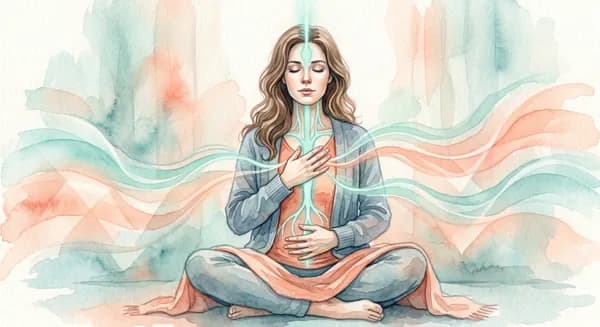
Nervous System Regulation: 5 Exercises to Calm Down
Nervous system regulation exercises are simple physical actions - slow breathing, cold on the face, humming, gentle movement - that nudge your body out of fight-or-flight and into rest-and-digest. They work because the vagus nerve, your main calming pathway, responds to the body before the mind. The fastest are surprisingly quick: cold water on the face drops heart rate 10-25% within 15-30 seconds through the mammalian dive reflex, and one Stanford study found five minutes of slow cyclic sighing improved mood more than meditation (Balban et al., 2023). You are not talking yourself into calm here - you are using your own physiology to shift state. This guide walks through five nervous system regulation exercises you can try tonight, when each one fits, and how to notice which actually settles you.
Wired right now? Start here
- 1Splash or hold cold water on your face for 15-30 seconds, forehead to cheeks - your heart rate drops within seconds.
- 2Breathe in through your nose, add a small second sip of air, then exhale slow and long through your mouth. Repeat three times.
- 3Close your lips and hum a steady Mmmmm on each out-breath for five breaths - feel the buzz in your face and chest.
- 4If your body is jittery, stand up and shake out your arms and legs, or take a slow two-minute walk.
Cold water on the face drops heart rate by 10-25% within 15-30 seconds via the mammalian dive reflex
5 minutes of daily cyclic sighing improved mood more than mindfulness meditation (Balban et al., 2023)
Try Our Interactive Feelings Wheel
130 emotions. AI-powered insights. Completely free.
Identify your emotions now
Try FreeNervous system regulation means helping your autonomic nervous system swing back from alarm to calm on purpose. Your body runs two gears: the sympathetic branch that revs you up (fight-or-flight) and the parasympathetic branch that powers you down (rest-and-digest). The vagus nerve is the main parasympathetic cable, running from your brainstem down through your throat, chest, and gut - and roughly 80% of its fibers carry signals from body to brain, not the other way around. That detail is the whole reason breathing, humming, and cold work: they speak to your brain in the body's language. When stress piles up and you get stuck in high gear - tense, wired, unable to settle even when nothing is wrong - nervous system regulation exercises give you a way back down.
On this page
Why Does Cold Water on Your Face Calm You Down So Fast?
When Should You Use Nervous System Regulation Exercises?
Is Polyvagal Theory Actually Real Science?
How to Use
- 1
Lengthen Your Exhale (the physiological sigh)
Take a normal breath in through your nose, then add a second short sip of air to top off your lungs. Now let it all out through your mouth in one slow, long exhale - aim for the out-breath to last twice as long as the in-breath. Repeat two or three times, then breathe normally. The extended exhale is what stimulates the vagus nerve. Notice your shoulders drop on the way out; that release is the parasympathetic shift starting.
- 2
Use Cold on Your Face for a Fast Reset
Fill a bowl with cold water (about 10-15C, add a few ice cubes), take a breath, and hold your face in for 15-30 seconds, covering forehead to cheeks. No bowl handy? Press a cold pack or frozen peas wrapped in a thin cloth against your forehead and cheeks instead. Expect a fast wave of calm as your heart rate drops. Skip this one if you have a heart-rhythm condition, uncontrolled high blood pressure, or cold sensitivity.
- 3
Hum to Stimulate the Vagus Nerve
Sit comfortably, breathe in through your nose, then close your lips and hum a steady Mmmmm all the way through the exhale. Feel the vibration in your throat, chest, and the bones of your face - that vibration is what mechanically stimulates the vagus nerve. Keep going for five to ten breaths, or set a timer for a few minutes. Humming is quiet enough to do almost anywhere and asks nothing of your busy mind - forgiving when you are too frazzled to focus.
- 4
Slow Your Breathing to About Six Breaths a Minute
Breathe in gently for a count of five, then out for a count of five to seven, landing near six breaths per minute. Use a clock, an app, or just count steadily. Keep it soft and unforced - not huge breaths, only slow even ones. At roughly six breaths a minute, your breathing syncs with your heart's natural rhythm and pushes heart rate variability up, a sign your vagal tone is engaging. Ten minutes is plenty; even a few rounds start to settle things.
- 5
Add Gentle Movement to Discharge the Charge
If your body feels jittery and stuck, give the stress somewhere to go: a slow walk, a few minutes of easy stretching, or shaking out your arms and legs. Movement helps clear the adrenaline and cortisol that pile up under stress, and slow, rhythmic motion cues your nervous system that the threat has passed. Keep the pace easy rather than intense - the goal is to settle, not exhaust. Pair it with a long exhale to send two calming signals at once.
A Worked Example: 11pm, Wired and Can't Settle
Say it's late, the day went badly, and your body won't power down - heart still going, mind looping, but you're exhausted. Here's one way to walk it back down with nervous system regulation exercises:
The order matters: body first to drop the activation, then slower practices to keep it down. Trying to reason yourself calm before the body settles is the step most people skip - and it's why nothing seems to work.
What to Remember About Nervous System Regulation
- Nervous system regulation works through the body first - breath, cold, vibration - because the vagus nerve speaks the body's language.
- Match the tool to the moment: fast resets (cold, the sigh) for spikes, gentle daily practice (slow breathing, humming) for a steadier baseline.
- When you're flooded, go body-first; thinking exercises stall until the activation comes down.
- These are reflection and self-help practices, not a cure - real help that sits alongside professional care, never in place of it.
- If you take medication for a related condition, talk to your prescriber before changing anything.
When to Reach Out for Professional Support
Nervous system regulation exercises help with everyday stress and overwhelm, but some signs mean it's time to involve a professional.
- Stress, panic, or feeling stuck in high gear persists for weeks and disrupts sleep, work, or relationships.
- You get frequent panic attacks, or dizziness, fainting, or heart palpitations without a clear trigger.
- You have a trauma history that keeps pulling you into freeze or shutdown that the exercises don't ease.
- You suspect an underlying medical cause (autonomic symptoms, long COVID, a heart condition) - get a medical evaluation.
If you have thoughts of harming yourself, contact a crisis line or emergency services now. EmoFlow is not an emergency service.
Research Evidence
Sources: Stanford University School of Medicine, NCBI / National Library of Medicine, Cleveland Clinic
Sources
- Brief structured respiration practices enhance mood and reduce physiological arousal (Balban et al., 2023) - Cell Reports Medicine
- Benefits from one session of deep and slow breathing on vagal tone and anxiety in young and older adults (Magnon et al., 2021) - Scientific Reports
- The Effects of Cold Stimulation on Cardiac-Vagal Activation in Healthy Participants (Jungmann et al., 2018) - JMIR Formative Research (NCBI/PMC)
- Physiology, Diving Reflex (StatPearls) - NCBI Bookshelf
Find the Right Nervous System Regulation Exercise in EmoFlow-AI
Here's the hard part of nervous system regulation on your own: when you're flooded, you have to guess which exercise fits and then somehow walk yourself through it. EmoFlow-AI removes both. As a mood tracker app, it starts with a quick check-in on the 130-emotion wheel so you can name what you feel and rate the intensity from 1 to 10. That rating drives the routing: at 8 or higher EmoFlow sends you to body-first tools like cold-on-the-face or the physiological sigh, because thinking exercises stall when you're overwhelmed; at 4 to 7 it opens up reflection and slower practices. Then a coach walks you through the matched practice step by step, so you don't count and remember instructions at once. EmoFlow-AI is not a generic chatbot improvising advice - it runs on real algorithms and validated, research-based techniques drawn from 80+ options. Over weeks, the mood tracker shows which emotional regulation techniques actually settle you, turning scattered self regulation techniques into a routine you can see working - real help for how to relieve stress and anxiety.
- Intensity routing sends you to body-first calming at 8+, slower reflection at 4-7
- A coach walks you through each nervous system regulation exercise step by step
- Pattern tracking shows which emotional regulation techniques actually settle you
For Mental Health Professionals
Recommend nervous system regulation exercises - paced breathing, the physiological sigh, cold-face activation, humming - as between-session self-regulation skills, and let EmoFlow-AI help clients rehearse them in the moment rather than only in your office. When a client does a check-in, the app records the emotion, intensity, and which exercise helped, so they arrive able to say 'cold water dropped me from a 9 to a 5 on Thursday' instead of reconstructing a vague week. Read-only PDF reports show which regulation tools clients reach for and how their intensity peaks trend over time, helping you see where a skill is landing and where it isn't. Clients control exactly what they share, so the data supports somatic and polyvagal-informed work without crossing boundaries.
- Clients practice somatic regulation skills between sessions, not just in the room
- Reports show which exercises clients use and how intensity trends over time
- Evidence-based, client-controlled data that fits polyvagal-informed and somatic work
Frequently Asked Questions
It depends on the exercise. Cold water on the face works in 15-30 seconds because the dive reflex drops your heart rate fast. A physiological sigh can ease tension in one or two breaths, and slow paced breathing usually takes a minute or two to feel. Building a higher baseline - so you recover from stress quicker in general - is the slow part: most people notice steadier nervous system regulation after a few weeks of daily practice, not a single session.
Yes, especially in the moment, because anxiety and panic are partly physical states that these exercises target directly. Cold on the face can interrupt a panic surge fast, and a long exhale shifts your body toward calm. Timing matters most: reach for a body-first nervous system regulation exercise at the first signs, before panic fully builds. These tools are real help, not a cure - if panic attacks are frequent or running your life, they work best alongside support from a professional.
The fastest reliable way to calm your nervous system is cold on the face. Holding your face in cold water, or pressing a cold pack to your forehead and cheeks for 15-30 seconds, triggers the mammalian dive reflex and drops your heart rate 10-25% within seconds. If cold isn't an option, a physiological sigh - a double inhale through the nose and a long slow exhale - is the next fastest nervous system regulation exercise, working within a breath or two. Skip cold immersion if you have a heart condition.
Yes. Cold-face techniques that trigger the dive reflex aren't for everyone. Avoid cold immersion if you have a cardiac arrhythmia (especially long QT syndrome), uncontrolled high blood pressure, Raynaud's phenomenon, cold urticaria, or if you've been drinking or taking sedatives. If you have any heart condition or autonomic issue, check with your doctor first. Gentler nervous system regulation exercises like humming, paced breathing, or the physiological sigh carry none of these cautions and are safe starting points for almost anyone.
Yes - humming creates vibration in your throat and the bones around your face, and that vibration mechanically stimulates branches of the vagus nerve that pass through the area. Research on humming and chanting links it to improved heart rate variability, a marker of vagal tone and nervous system balance. It also takes almost no effort or focus, which makes humming a forgiving nervous system regulation exercise when you're too overwhelmed to concentrate. Try a steady Mmmmm on each exhale for five to ten breaths.
For everyday stress, simple exercises do the job - no device required. Implanted vagus nerve stimulators are medical treatments for specific diagnosed conditions, prescribed and monitored by doctors, and aren't a stress-relief gadget. For calming your nervous system day to day, free nervous system regulation exercises like slow breathing, cold on the face, and humming activate the same parasympathetic pathway. If you take medication for a related condition, talk to your prescriber before adding or changing anything; these exercises sit alongside care, not in place of it.
Related Techniques
Related Articles
EmoFlow-AI provides evidence-based education - not medical advice, diagnosis, or treatment - and is not a substitute for a qualified mental-health professional. If you are in crisis or may harm yourself, contact local emergency services or a crisis line now.
Ready to try the interactive feelings wheel?
Start a Check-in